Showing posts with label Comics. Show all posts

Friday, 23 June 2023

Thor: Love and Thunder - A Messy Fantasy Romcom about Learning to Be Vulnerable

So, here we are again. It's been several years since I last updated this blog, way back in December 2020. Hopefully, people will still want to read what I have to say. Fittingly enough considering the subject of this article, my last piece was about how a Thor comic helped me hold on to hope in a dying world. But let us turn our attention to the present and today's focus - Thor: Love and Thunder

Ah, Love and Thunder. Rarely has a MCU film been so divisive or misunderstood. 

As we approach the one year anniversary of its release back in July of 2022, I want to reflect on why this film has been worming around in my head, how I can't seem to let it go despite how its flaws or how messy it is. Why a lot of people genuinely do not seem to understand what Taika Waititi was doing with Thor, and why Thor: Love and Thunder is a classic Thor adventure about loss, love, trauma, and false bravado.

"A classic Thor adventure? You must be joking."


How did we get here?

If you've read my blog before, you will know that I wrote a very long and personal piece about my complicated relationship with Thor and his chaotic character growth throughout the MCU back in 2019. Please read if you haven't, aside from giving a more detailed summary of how we got here than I will provide here, it's probably my favourite of the articles I've written for this blog and was strangely cathartic to get out. 

As detailed in that piece, Thor's arc in the MCU has been one of progression and regression across his six film appearances up to that point, a struggle between being the king he was born to be and the good man he is trying to be, between false bravado and humility, between love and loss. Thor's character is an examination of fragile masculinity and ego in the pursuit to be worthy.

To quote my previous article as means to recap:
In his first solo film and in The Avengers, Thor gains humility after being stripped of his powers and learning the value of self-sacrifice, not to mention how to work in a team of equals. In The Dark World and Age of Ultron, he learns to build instead of destroy, creating Vision and fearing the destruction he might cause. So naturally it is in Ragnarok that he achieves self-understanding and realises his best self.
However, as we all know, this progression is not a straight line for Thor but an ongoing circular struggle to find a sense purpose on his journey towards worthiness. Which is why Thor goes from the fully realised and complete "version of himself who no longer relies on external symbols of power, such as his hammer or titles, but instead recognises his own inner strength and doesn't need to prove anything to anyone" in Thor: Ragnarok...

This moment here, in case you forgot.
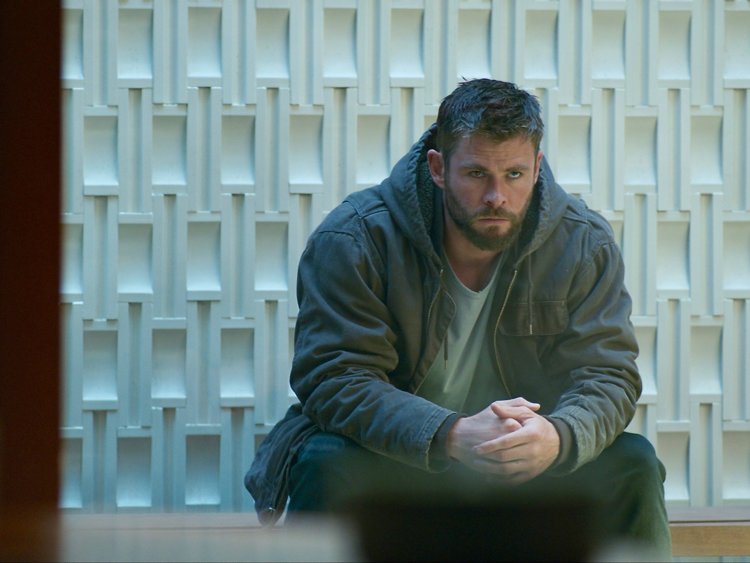
To a god broken by all he has lost and desperate for revenge in Infinity War and then finally the depressed shattered shell we see in Endgame, a man wracked with guilt and PTSD who hides his feelings under a dad bod fueled by pizza and copious amounts of beer. Again to quote my previous article (last time, I swear): 
Thor is stripped of all the visual symbols of the wisdom he gained [in Ragnarok] and is reduced to a man driven by vengeance. A vengeance fueled by rage that masks his trauma and serves to obscure his grief and despair. How does Thor express this vengeance? By reverting fully into his old arrogant facade of desperate bravado, unable to admit his failings or emotions to himself, let alone to others.

This is made clear in his emotionally wrenching conversation with Rocket where he is so obviously a man in pain and dealing with deep grief but cannot let the facade of "Mighty Thor" down.

Sure, bud. Whatever you say.

It is in Endgame where Thor's facade finally breaks, where he finally allowed himself to be vulnerable and expressed his fears openly and honestly. I naturally am referring to the scene where he speaks with his mother. The scene which gives us the line which sums up Thor's struggle in the MCU up to that point: "Everyone fails at who they're supposed to be, Thor. The measure of a person, of a hero, is how well they succeed at being who they are." 

So, Thor ends Endgame adrift, no longer burdened by the weight of expectations from his birthright to the Asgardian crown or his desire to be worthy. As he says to Valkyrie when she asks what he will do, "I'm not sure. For the first time in a thousand years, I... I have no path. I do have a ride, though."

And this is where Thor: Love and Thunder picks things up.


Alone in the Crowd - The Asgardians of the Galaxy

While the film opens with Gorr, and we will get to Gorr, don't worry about that, I would like to start my examination of Love and Thunder by discussing that ride Thor got at the end of Endgame and the function of the Guardians of the Galaxy in the film.

Now, I know some people were upset by the limited time the Guardians spent in the film. I initially was a bit confused why they are in the film for about 30 minutes before they jet out of there, happy to leave the Chud of Thunder behind. But that's the point. This is Thor's story, the Guardians are just there to help begin his journey towards vulnerability and love. 

At the beginning of the film, Thor is completely adrift. As Korg says in his voice-over narration, which frames the film as a legend told to children around a campfire, 
But beneath this God bod, there was still a sad bod just trying to get out. Because all of the bods that Thor had worn over the years couldn't hide the pain that he was feeling on the inside. So he gave up his search for love, accepting he was only good for one thing... Waiting in quiet contemplation for someone to say, 'Thor, we need your help to win this battle.'

On a sidenote, it boggles my mind when I see people say they don't know what Love and Thunder was about. The film literally has Korg say out loud the themes of the story, either in narration or directly to other characters, multiple times. If anything, the film is too blunt about what it's about, but I digress.

Unable to find sense or purpose in his adventures with the Guardians and still wracked with grief and unable to process his loss, he is pompous and careless, not really aware of how his actions or behaviour impacts on others. All of which is perfectly established in the first fight scene on the planet Indigarr.


To be clear, I think this scene is great. The over-the-top ridiculous action, the late 80s heavy metal fantasy aesthetic with Jim Henson inspired puppetry, all set to Guns N' Roses is perfect. No notes. 

It also perfectly sets up Thor's arc for the film. We can see this in how Thor is late to the battle, too busy with quiet contemplation to join the fray but still chides Star Lord and Mantis for not hurrying up since "people are dying". When he arrives on the battlefield, King Yakan comments that he has finally join their fight and Thor responds, "You know what they say, better late than not at all." 

Thor seems incapable to take responsibilities as a god or a hero seriously because he sees no purpose in the constant fighting. This is Thor without purpose, a grandiose caricature of himself, leaning into a braggadocios version of his own legend. This is clear in how Thor focuses on heroic mythmaking rather than saving people, illustrated in how he instructs King Yakan to:
"Tell them what happened here today, tell them of the time that Thor, and his ragtag motley crew of misfit desperados, turn the tide in the battle and etched their names in history. For the odds may be against us, but I'll tell you this for free - this ends here and now!" 
Where in prior films Thor's false bravado was a way for him to hide his insecurities and sense of unworthiness under a layer of arrogant machismo, here it serves to distance himself from others and to avoid being hurt by putting on a front.

And it is a front that the Guardians are completely fed up with. While Star Lord might mouth along with Thor's declaration that "This ends here and now!", his comradery quickly erodes into frustrated annoyance at Thor's pompous grandiosity as the fight goes on. Notice Star Lord's massive eye-roll, Drax's unimpressed face, and Nebula's glare when Thor does the Van Damme splits between two Booskan Raiders before blowing them up - this is Thor showboating for no reason and they all know it. 

"Can you believe this guy?"

And Thor doesn't even accomplish the thing he is supposed to, which was to liberate their sacred shrine. He destroys it through his carelessness and desire to look suitably 'epic' while defeating the enemy. The front he has put on might create distance from others so he isn't hurt, but it doesn't stop Thor from unwittingly hurting others through his apathetic actions.

Furthermore, Thor's act isn't fooling anyone. Perhaps because he has also often put up a braggadocios persona to hide his feelings but Star Lord sees right through Thor and tries to connect with him. He notices the distress Thor is in when he sees his friend Sif is in danger and asks if he is okay. 

In an example of the film again blatantly telling us what it is about, Thor says he admires the Guardians' commitment to each but it's something he can never have. Then Star Lord tells him straight up, "After thousands of years of living, you don't seem to know who the hell you are" and to "Remember what I told you, you ever feel lost just look into the eyes of the people you love, they'll tell you exactly who you are". Wow, it's almost like he's setting up Thor's character arc and the themes of the film.

Despite all their adventures together (shown in extended montage and set to Enya), Thor never allowed himself to open up and truly join the Guardians. He never became part of their family because he refused to allow himself to be vulnerable or grow attached - so he grew adrift and lost purpose instead.

"Okay, bye guys. Have fun on your next adventure,
I'm sure it won't be emotionally damaging or heart-wrenchingly traumatic."

Then the Guardians get out of dodge, leaving Thor with Korg and the screaming goats to save Sif and join the plot proper. While it might have been an anticlimactic goodbye, the use of the Guardians effectively sets up the struggle Thor will grapple with throughout his story.


Rainbow in the Dark - A Bombastic Heavy Metal Fantasy

Okay, I have to talk about the film's aesthetic. I love this look. Like most things, aesthetic is a nebulous thing and subjective as all hell - either you vibe with it or you don't - but I think the late 1980s metal visuals are a perfect fit for Thor, particularly Waititi's Thor. 

In an interview with Rolling Stone, Waititi said he was heavily inspired by the ridiculous over-the-top nature of metal band logos and wanted the film to be an 80s style adventure, saying “You know, just the whole thing, like all the art and everything - it feels like an 80s album cover.”

Yeah, that tracks.

And the innate ridiculousness of this aesthetic serves not only the adventure feel of the film but also the comedy which serves to point out the inherent silliness of the superhero genre and the pomposity of our glorious himbo God of Thunder.

Again, this is reflected in the opening fight scene on Indigaar's loving homage to Jim Henson classics like Fraggle Rock or Dark Crystal in the design of the Booskan Raiders and their vehicles, as I mentioned earlier. 

Furthermore, the heavy metal aesthetic fittingly serves the story being told, one of irreverence but with a beating emotive heart under the surface, just like how metal bands would cover their sappy love ballads in distorted power chords and blistering guitar solos.

Talking about guitar solos, in addition to the inclusion of three Guns N' Roses songs and Dio's "Rainbow in the Dark", Michael Giacchino's score mirrors this feel perfectly. Giacchino utilises screeching guitar licks and thunderous drums with slick eletronic synths to supplement his traditional swirling superhero string arrangements to complement the metal vibe of the visuals.

Waititi also stated that “Thor with the singlet, that’s obviously a homage to Big Trouble in Little China, to (Russell’s character) Jack Burton.” Possibly the fact that Big Trouble is a favourite film of mine probably explains why I thought Thor's singlet and sleeveless jacket look is the coolest shit.

I'm sorry, but this is just a baller look.

Speaking of things subjective...


"They turned Thor into a joke!" - Understanding the humour behind Taika's Thor

Now, not everyone is going to like every joke and not every joke is designed to be for everyone, which is fair enough. Thor: Love and Thunder is a pure comedy for most of its runtime, when its not being an 80s adventure or a love story (we'll get to Jane soon). That means if you can't get its sense of humour, you're probably not going to have a good time.

Although, there are some people do not like an overly comedic tone in their superhero movies at all because they believe that superheroes must be treated MATURELY. These people seem to mistake a comedic tone for derision or lack of RESPECT for the source material. The fact comics are inherently silly (which is part of why they are great) and that Thor canonically turned into a frog in the comics doesn't seem to matter much to that sort of angry comic book nerd.

Hell yeah, Throg rules!

There is a fair argument to be made that there are far too many weightless jokes in Love and Thunder, particularly the ones like Valkyrie and Jane bobbing their heads to the speaker which looks like a hand grenade. A lot of these jokes seem like pointless improv which should have been left on the cutting room floor and often fall flat or raise a bemused chuckle at best.

However, a big source of humour in the film is the juxtaposition between the caricature Thor presents himself as and how oblivious he seems to how he is actually perceived by others. See how King Yakan refers to Thor as "God of Destruction" after he destroyed their sacred shrine but which Thor doesn't even seem to acknowledge. I would argue that those jokes which revolve around how Thor's braggadocios persona is shown to be empty and undercut by the reaction of the people around him serve a vital purpose for Thor's character arc, just as they did in Ragnarok.

As mentioned earlier, Thor's ridiculous bravado and oblivious himbo persona is an act designed to keep people at arm's length so they cannot get too close. It is defense mechanism for Thor and one that fits him like well-worn leather since he's just adapted the old uber-masculine façade he used to hide his insecurities and sense of unworthiness into a shield to prevent anyone getting too close.

We see this clearly in Thor's early interactions with Jane in the film.

It's very normal to pop out the wings on your helmet to assert your manhood.

Before he knows it's Jane wielding the restored Mjolnir, Thor confronts this 'stranger' by donning a grandiose golden costume with a ridiculously ornate (CGI) helmet. This wardrobe change signals how Thor feels a need to perform a caricature of himself and that we are meant to laugh at him, to see he is being ridiculous and that this is silly. 

As this article in Film Obsessive argues, "Like a jester figure, Waititi takes jabs at every trope he’s inherited: cackling at the costumes, the props, and the heroic gravitas of his beloved cast of comic book characters." However, this isn't a lack of respect for the source material or the characters. Waititi's irreverence serves a purpose. In addition to reinforcing the notion that, at the end of the day, superhero archetypes are inherently silly (which is a good thing and we should be willing to embrace that silliness), it "humanizes Thor as a relatable manly man—a Himbo who can oscillate at the snap of a finger from a dad-bod to a god-bod [to a sad-bod]".

Indeed, Thor's bumbling stunned response once he realises it is Jane wielding his ex-hammer is incredibly relatable. He rips off his ridiculous helmet and tugs at his collar from a hot flush. He stammers over his words and tries to reassert his previous braggadocios persona but is even less convincing than he was before. 

Jane is not fooled anymore than Star Lord was. She knows Thor and she can see that this is not the real him, which is reflected in Natalie Portman's performance. Jane constantly reacts to Thor's awkward bumbling and false bravado with a upturned mouth or slightly raised eyebrow, as if she is wondering why he is acting like such a fool but willing to indulge him.

We can also see this in how Thor struggles at first to reconcile the fact the previous symbol of his manhood, Mjolnir, is wielded by Jane and in ways he never could.

Korg yet again saying the themes of the film out loud for the audience.

We'll come back to Jane and Thor in a moment but first I'll like to talk about...


The Gorr of It All - Comic Book Adaptation vs Adapting a Comic Book Character

I think most people appreciated Christian Bale's portrayal of Gorr and wished there was more of him in the film. I personally would have like Gorr to challenge Thor's ideology or perspective of the gods, the same way he did in Jason Aaron and Esad Ribic's fantastic story arc in the comics or even how Kilmonger gets T'Challa to change in Black Panther

The whole scene on the Shadow Realm planet where Gorr taunts our heroes with the truth while they struggle is chilling and honestly one of the best in the film. There is no comedy here, just pure tension and suspense.


The fact that each of our heroes knows that Gorr is correct only adds to the sense he is ultimately under-used in the film. Their terrified and upset reactions highlight the truth of his words. The gods will use Jane but not help her or cure her cancer, The gods did not help save Valkyrie's fellow warriors and lover as they died in battle. In fact, the Valkyrie's were in battle for a god - on Odin's orders to stop Hela - and he did nothing to save them.

However, I'm not going to spend a heck of a time on this since everything I want to say about Gorr is probably summed up better by Pillar of Garbage's excellent "The Gorr Dilemma: Critiquing Adaptation" video.

To poorly summarise Pillar's argument, while movie Gorr is similar to comic book Gorr, he is not the same since the original Gorr storyline would not fit the focus of Thor: Love and Thunder which is Thor's personal journey to learn to be vulnerable and love again. 

This is reflected in how both Gorr's have a similar origin but there are slight, yet important, differences. Both versions of Gorr present a man driven to despair by the inactions of the gods he worships, who comes across two gods, one alive and one dead, and takes up the Necrosword to slay the alive god, before going on an intergalactic crusade to kill all gods. However, the key difference is in how and why each version of Gorr slays the first god.

In the comics, the god is wounded and asks Gorr for help. This causes Gorr's faith to be broken completely as he learns that the gods aren't omnipotent or benevolent, that his people weren't special or chosen, that godhood is a sham. In the film, unlike the space age design of the comic god, the god Gorr meets looks mostly human, if covered in gold. He does not appear alien but familiar. Movie Gorr does not kill him out of outraged morality but pure rage, fueled by the corrupting influence of the Necrosword, as an act of vengeance for the death of his daughter. It happens just after his god mocked him for believing in him and as his god is chocking him, almost an act of self-defense. It is not the existential grief of a man who has lost his faith like in the comic, it is far more personal.

Movie Gorr is driven by love and grief... the very same things which our lovable God of Thunder is struggling with. Therefore, although it is clear that Gorr is right in his assessment of the gods unworthiness of being worshipped, the film provides no clear counter-point. In the comic run, Thor knows that to prove Gorr wrong, he has to continually answer prayers and perform miraculous acts of labour and heroism to justify his existence as a god. Film Thor doesn't really have a retort to Gorr aside from the fact that Gorr might be as hypocritical as the gods, which sure, I guess.

However, the fact movie Gorr and Thor's motivations are both personal and essentially the same is the point. While I would have liked Thor to see how Gorr's crusade to kill all the gods for their petty selfishness and callous disregard for their worshipers is not dissimilar to Thor's own anti-colonialist recognition that "Asgard is a people, not a place" in Ragnarok, this is a personal story, not an overtly political one.

This Gorr is not an adaptation of the comic Gorr but has adapted Gorr to suit the needs of the film and serves Thor's arc. As Pillar points it, "the centre of this film is Thor's journey towards emotional maturity. This arc is the point around which every other aspect of Love and Thunder is oriented." In this way, movie Gorr is the same repressed individual driven by revenge that Thor was in Endgame and who Thor could be if he didn't work towards becoming authentic and emotionally honest version of himself.

Which is why the truth Gorr taunts Thor with is about love and pain.

Love is the central conflict Thor struggles with in the film, not Gorr. This is why Gorr tells Thor to "choose love" and call Stormbreaker to save Jane. Thor's main journey that leads him to change is not the goal of stopping Gorr but the realisation he wants to be love, and be loved by, Jane, to be confident enough to open himself up to someone else, even at the risk of getting hurt yet once again.

Which brings us to...


"You made me worthy" - The Legend of Thor and Dr. Jane Foster

Okay, some nerds who are way too precious about things are going to be upset but Thor: Love and Thunder is not really a superhero film. It is a 80s adventure fantasy based on comic book characters. That difference might seem like splitting hairs but it is important. 

In a lot of ways, when Thor isn't hanging out with the Avengers, he's not really a superhero. He's heroic, sure, but not really a superhero as we tend to think of them. He doesn't have a secret identity or a symbolic costume or even really fight crime. Instead, he has grand epic adventures across the galaxy, hunting monsters, battling gods, and confronting intergalactic beings beyond comprehension. His stories are more mythic and fantastical than a superhero on a crusade against crime.

I bring this up to lead to my next point about genre - in addition to being an 80s styled fantasy, Love and Thunder is a comedy (duh) but more than that, it is a ROMCOM. At the centre of this story is the relationship between Thor and Jane.

Aww, look at these two.

Before we get into their relationship, let's talk romcom for a bit. As this helpful article from Collider points out:

The romantic comedy genre is one that's full of distinct tropes. The meet-cute, the burgeoning relationship montage, the third-act breakup, love being rekindled, the crazy ex, the scene that pulls on your heartstrings.

Love and Thunder plays with these tropes in interesting ways. Firstly, Thor and Jane have already had an entire relationship that dissolved in the past, so their meet-cute in this film is not meeting someone for the first time but someone bumping into their ex. As discussed above, this shows Thor in a different light, awkward and bumbling, unable to maintain his overly-confident façade.

This playing with romocom tropes also explains the weirdly obsessive way Thor reacts to Mjolnir's return and Stormbreaker's jealousy of Mjolnir by reworking the crazed romantic partner trope through Thor's signature two weapons of choice. The jokes about Thor trying to call Mjolnir and Stormbreaker not working properly out of jealousy are rooted in this trope inversion. Once you understand what that Love and Thunder is playing with these tropes in this way, a lot of the 'awkward' comedy in the film makes more sense.

"No, baby, I wasn't thinking about her. I was actually just about to call you... beautiful."

Similarly, instead of the typical burgeoning relationship montage, since Jane and Thor have already had a relationship, we have a romance and subsequent break-up montage, fitting set to ABBA's classic "Our Last Summer". Also, Korg's voice-over narration gives another layer of pathos under the corny humour of a shmaltzy romcom montage.

Thor set his sights toward a future and all it might hold. But the more he pondered a life with Jane, the more he feared losing that life. And although Jane didn't want to admit it, she was scared of loss as well. And so, they built walls between them. Thor got busy saving humanity. And Jane got busy doing the same. Real busy. And eventually, the space between them grew and grew until it became too wide to bear. Something had to give.

Hey, isn't that the thing I've been harping about, how Thor's false bravado is a wall to keep people distant? Stop telling the audience the themes of the film, Korg! Seriously though, this is a sad account of Thor and Jane's relationship. Instead of being vulnerable and open about their fears, they retreated into themselves and drifted apart. 

As this article on Jane and Thor's romance says, "Often heartbreak can lead someone to harden their hearts to love. In Thor’s case, he numbed his heart into believing that his only purpose is to fight when called upon." This is exactly where we find Thor at the start of the film, adrift and alone.

However, it is through being reunited with Jane and the rekindling of their relationship that Thor realises that it was Jane who made him worthy and that he wants to open up and love again. It's on the way to the Shadow Realm that Thor reveals to Jane that she made him worthy. His path to reclaim his self-worth began when he crash landed in New Mexico and Jane hit him with her car. In his own words, "I wanna feel shitty about you. I wanna feel shitty about something and I think that's you."

In another example of romcom subversion - instead of a third act break-up, we get a third act make-up.

I have to talk about the hospital scene for a moment. Thor, now aware Jane has cancer and that Mjolnir is draining all of her mortal strength and killing her, wants to leave her behind and go face Gorr alone. Not because he doesn't believe she could help or because he doesn't want her by his side in battle, but because he loves her.

This declaration by Thor that he loves her is the first time across eight movie appearances, four of which he was in a relationship with Jane, that we hear Thor say it out loud. Possibly it is the first time Jane has heard it too, judging by the stunned look on her face. It honestly is heart-wrenchingly earnest in a film which had been so irreverent before, pretty much up to the point where Thor begins to open up and admit his feelings out loud.

However, Thor does not force Jane to stay in the hospital. He recognises it is her choice and tells her so, but his love for her means he wants to try at a second chance if they can. As he says,


While Jane does initially decide to stay in the hospital, when she senses that Thor is losing his fight with Gorr, she picks up Mjolnir and suits up as the Mighty Thor one last time. The look of anguish on Thor's face when he sees her arrive is tearjerking as he knows that this will kill her but he does not argue with her or force her to leave since he respect her decision. 

He is no longer the broken sad bod hiding under a god god and an offish braggadocios persona. He wears his heart proudly on his sleeve in a healthy non-toxic masculinity which doesn't seek to keep people at a distance but allows them in - more on that in the last section.

This is why during the last scene at the Altar of Eternity, Thor does not fight Gorr to stop him making his wish, he chooses to be with Jane and cradle her in his arms during his and her last moments, an image that parallels Gorr cradling his dying daughter. He tells Gorr to choose love (throwing the God Butcher's words back at him) when making his wish and promises to look after his daughter with Jane's approval. 

Love is the purpose Thor finds in his long journey towards meaning. Which brings us to...


"From god bod to dad god" - The Ballad of Love and Thunder

In yet another example of Korg spelling out the theme of the film to the audience so there's no confusion, he tells Valkyrie on the way to the Shadow Realm that he "thinks Thor would be a great dad". And so it came to be.

We see hints of this theme in more subtle ways throughout the story through the kidnapped Asgardian kids. Thor's interactions with them are fumbling at first, still trying to maintain his mythic "I am Thor" façade and instill false confidence. Over time, particularly after the confrontation with Zeus at Omnipotence City, he eventually speaks with them more openly and genuinely praises them for being braver than he was at their age. This leads Axl to declare, "I'm glad I met my hero." to Thor.

Then, in what I believe is one of the best MCU climatic battle scenes, Thor share his power with the kids, even the non-Asgardian ones, since they are all worthy and Space Vikings on this day.


There's a lot to like in this scene:
  • the pitch-perfect use of the outro solo from 'November Rain' to score the action 
  • how the lyrics of the song reinforce the themes ("Don't ya think that you need somebody?/Don't ya think that you need someone?/Everybody needs somebody/You're not the only one")
  • how the visual of Thor sharing his power with the kids recreates Yggdrasil the World Tree
  • the fun action of the kids fighting the shadow monsters, probably the best action sequence in the film after the amazing Shadow Realm fight. 

Also, as a keen-eyed YouTube commenter noted, there is something vital in the wording of the spell Thor casts to share his power. Thor says, "Whosoever holds these weapons, and believes in getting home, if they be true of heart is therefore worthy, and shall possess... for limited time only, the power... of Thor!" While it's similar to the enchantment Odin placed on Mjolnir, the key difference is Odin said "if he be worthy". Thor instead says, "is therefore worthy". The kids' worthiness is understood and acknowledged, by someone who's had a lot of doubts about his own.

We can only hope we have someone in our lives like Thor who recognises that we are worthy and we do not need to prove our worthiness to them, or to ourselves.

As this video by Implicitly Pretentious on Thor vs Genre Theory points out, the wider thematic genre of integration, which Love and Thunder falls into, is themed around resolving personal antagonisms, building community, and cooperation. 

This is why Thor bestows the children of Asgard with his power. This is why Jane dies saving the children and Gorr does not follow through with his crusade for vengeance but ultimately resurrects his child by choosing love. This is why Thor looks after Gorr's daughter after his own love, Jane, died. As Implicitly Pretentious states: "it is the ultimate symbol of this [integration]… just as Odin adopted Loki, the baby of an enemy, Thor does the same".

Quality family time.

Feeling Shitty - Final Thoughts on Love and Thunder

This is why I believe that for all its faults and messiness (for example, some of the blocking during dialogue scenes is absolutely atrocious), Love and Thunder has got into my head and my heart. Why I believe it is truly a classic Thor adventure about learning to love again. 

To be honest, I did not think this article was going to be this long. I genuinely thought this would be a brief defense of the film, a quick, short article. However, to quote J.R.R. Tolkien, "the tale grew in the telling", and it was in telling this tale, that my appreciation of the film only deepened.

So, give Love and Thunder a rewatch with this perspective in mind or watch it for the first time if the initial hate train turned you off it. If you can vibe with what the film is trying to do and get on its wavelength, you'll find that under its irreverent comedy is a sincere and open emotional heart. 

Then you might just fall in love with it too, warts and all.


References:


'Thor: Love and Thunder': Thor and Jane's Romance Made Each Worthy


Thursday, 31 December 2020

Thor: The Last Days of Midgard - How to Hold onto Hope in a Dying World

How do we save the environment from the seemingly insurmountable forces of capitalism, an ideology determined to destroy the planet as it extracts every last resource from it?

Intro & Context

Regardless of the blatant and apocalyptic detrimental impacts they have on the very planet we live on, unregulated and rampant business interests will be protected by the state. This should be obvious when the political elite are often in the pocket of oil companies, billionaire tech-bros, and industries who profit from the exploitation and pollution of the Earth. 

While the general population suffers and the planet dies as a direct result of their actions, the business class will continue to strip the world of its resources for short-sighted gains at the expense of our long term future.

It is a problem so insurmountable that even a god cannot fight climate change without being confronted by the impenetrable web of corporate greed and a legal system designed to protect the interests of capital and business. That's the lesson that Jason Aaron's Thor learns in the fantastic Thor: The Last Days of Midgard arc from 2012 (Thor: God Of Thunder #19-25).

Who needs Aquaman to save the ocean when Thor can swim?

However, it is not the lesson I learnt from this comic but we'll get to that. First, some backstory.

Backstory (to the Worst Year Ever)

This year, 2020 if you're reading this in the future (presuming there is a future), I had started to fall into despair at the state of the world and my inability to affect change on it. I was wound tight with stress, feeling the weight of the world on my shoulders and starting to crumble under the pressure. 

The resurgence of populist fascism, the enduring destruction of late stage capitalism, gross immoral inequality, a global pandemic, the fact that the world is literally on fire... and all I could do was watch it unfold on a computer screen. 

It feels overwhelming because it is overwhelming. It is too much and it all seems doomed. It is relentless, a constant feed of bad to terrible news, a desolate wasteland where nothing is able to bloom. It is as though you're in the middle of the ocean and dying of thirst. Cut off and alone, unable to connect or contribute to make things better since you can't latch onto anything or see a way forward.

What can you do when confronting destructive giants far greater and more powerful than yourself?

In the face of this unceasing toxicity, I become cut off. I was unable to be present in the here and now, in my own life. I was too consumed by what was happening abroad in other countries or the latest online discourse, the latest injustices committed by this corrupt state, politician or corporation, and so on, that I was unable to be fully present at work, with my friends, or even my family. 

I was tethered to the endless stream of terrible news that unfolded daily on my Twitter timeline...

And I believe I'm not alone in the loneliness caused by the hellscape that is social media. Too many of us feel cut off. Too many of us feel alienated and disillusioned by the constant suffering in the world and the failure of modern liberal democracies to meaningfully address the issues plaguing the world today. 

Issues of rampant corporate greed, the unequal distribution of resources, the gross exploitation of late stage capitalism, the continuing systemic bigotry of our societies, the inept responses to a global pandemic, and the ticking bomb of climate change. I mean, due to the dominance of neoliberal ideology which places the failures of society on the individual, often these democratic systems which are supposed serve the people deliberately make these issues worse when they aren't too busy ignoring them.

So the central question becomes, "How do we hold on to hope in dying world?". 

What if there is no one to smite since capitalism has no face to punch?

Let's Discuss the Comic

In Last Days of Midgard, there are two story-lines that are told in parallel which mirror and comment on one another. 

The first is Present Day Thor as he gets entangled with ROXXON Energy and its CEO Dario Agger, who, as Thor puts it, "seeks to poison Midgard for financial gain". Here Thor faces challenges not only in physical battle and of the magical variety but also of legal red tape and corrupt bureaucracy set up to protect the business elite. 

The second story-line is set millennia in the future, as old King Thor battles Galactus to prevent him from devouring a barren Earth which long ago died and is now just a dusty, hollowed out husk.

I'm sure there's no pointed commentary about our real-life future being made here.

The two story-lines are told simultaneously, mostly with the future plot adding layers of pathos and dramatic irony on the present day story. 

In the Present story-line, antagonist Dario Agger is the perfect embodiment of the modern neoliberal tech-bro, full of empty PR spin to obfuscate exploitative business practices. He also makes Elon Musk-like grandiose proclamations of his company's (modest) accomplishments, and expresses an insatiable desire to privatise vital resources from the public good. 

I mean, this is a man who wanted to establish an interplanetary ice pipeline to mine water from one of Jupiter's moons to "solve" the Earth's water crisis. 

I dunno man, you seem more preoccupied with the taking part...

Thor knows that Agger is actively destroying the planet and polluting the air but as Agger points out that neither he or his company "have never been convicted of any wrongdoing by any court in the world". In the eyes of the law, Agger and ROXXON are innocent and it is Thor who is the aggressor by thwarting ROXXON's enterprise by trying to stop them from destroying the planet. 

To be fair, Thor is deliberately destroying ROXXON facilities which hurts their profit margin and makes their shareholders sad. On the other hand, some of those facilities are so completely toxic that they have to be fully automated since no humans can work there, so yeah. Funnily enough, ROXXON cannot claim insurance since the insurance company is refusing coverage since the damage was caused by an act of god. Cute.

Fittingly, Thor is teamed up with Agent Rosalind 'Roz' Solomon of S.H.I.E.L.D's first ever environmental task force for this arc. Agent Solomon is a pragmatic idealist who wants to save the environment and believes it is possible but fully understands it is an uphill battle where you not only have one hand tied behind your back but also a chain around your ankles while your opponent has had a 20 year head start and more resources than you can imagine.

Of course, S.H.I.E.L.D are an espionage, special law enforcement, and counter-terrorism agency in Marvel comics. They are analogous to the CIA, by which I mean they're basically an arm to enforce American imperialism under the guise of counter-terrorism. So, that sucks and is a mark against Roz but she seems to have her heart in the right place.

However, the real take-away from this Present Day plot is how even the mighty Thor is in some ways powerless to stop the machinations of capitalism. 

Agger relocates ROXXON's floating factories to Broxton, a small town next to where Asgardia (the remnants of Asgard on Earth, home of Thor and the gods) is in an attempt to hurt Thor by buying up most of the town, displacing his friends and neighbours. And when Thor tries to fight Agger directly, he is served with a sue notice for damages done to ROXXON Energy.

What good is a hammer against a court action lawsuit?

It's quite interesting to watch Thor try to attack Agger head on, only to be hit with a lawsuit and restraining order, a fantastic example of how corporations will use the law to their own means in order to stifle criticism and activism. The law is on Agger's side because he has unlimited capital and the law is always on the side of those with capital, largely because it was written by people with capital. Funny that. 

Naturally, since this is a superhero comic, Agger turns out to be a Minotaur and hires trolls to kill Thor, which means Thor can smack his face with his hammer. Unfortunately, the town of Broxton is destroyed in the ensuing battle, showing how it is always average everyday people who suffer under capitalism.

Moving to the Future story-line, old King Thor, having seen the millennia since the events of the present day plot, as well as the death of all his friends and allies from that time period, stands in the dust of a dead Earth. Lamenting the loss of his beloved Midgard, who should arrive but Galactus, the devourer of worlds.

Galactus is a perfect metaphor for the unceasing need for perpetual growth and expansion, not to mention the destruction left in its wake, fundamental to the functions of capitalism. Galactus is famously always hungry. No planet, no matter how large or rich in resources, can satiate his burning desire to consume more and more and more until the end of time. He must always have more, constantly travelling the galaxy forever consuming. Just like capital, Galactus must feed.

But Thor says thee nay!

Visually, they made the rather deliberate choice to have Galactus give off bellows of smoke and ash, polluting the air with his mere presence. Oh well, sure there's no wider meaning to be read here.

Before they begin their battle, Galactus and King Thor discuss the Earth and why they want to devour or save it, respectively. Thor points out that the Earth is already half dead, and asks why he would even want to eat a world such as this. However, Galactus turns the question back on Thor, questioning why would he want to defend it. Their answers are quite illuminating.

Thor responds that the Earth has saved him more times than he can count while he hasn't saved it nearly enough. Galactus similarly states that the Earth has defied him more times than he can count and no matter its current state, the taste of it will be sweet.

Thor's response points out our duty to the world we live on, to nurture it and take care of it as it provides for us, while Galactus' reply highlights the pettiness and desire for conquest inherent in capitalism's need for perpetual growth and consumption.

It is interesting, that Thor then thinks to himself that it would so easy to let it slip away just by doing nothing. Perhaps it would be a mercy to let the planet be consumed... however, Thor is not the god of Mercy and stands his ground against a being far larger and more powerful than he is.

When standing up to a giant, simply breaking his hand is a victory of immense proportions.

I won't retell all the events of their battle here since it would take too long and distract from the point I'm trying to make but suffice to say, it is epic and a tale worthy of being told. 

Fittingly, Thor's granddaughters, the Girls of Thunder join the battle when Thor is knocked out and attack Galactus, causing some significant damage, even if they ultimately are unable to defeat him without their grandfather's help. It's almost like in order to defeat a monster like Galactus or capitalism, we cannot do it on our own but only if we work together.

Again, this is a superhero comic and Thor retrieves an all-powerful weapon that helps him defeat Galactus, although it is one which corrupts his soul as he uses it. What is fascinating is that during this part of the battle, Thor reveals that it was he that caused the destruction of the Earth by standing by and allowing it to fall. It was his inaction that lead to the death of the planet.

However, at the end of the battle, Thor bleeds from his wounds onto the ground, causing it to grow anew. 

I hope the message isn't too subtle...

But rewinding to the end of the Present Day plot, following the destruction of the town of Broxton, Thor and the Asgardians ask to help the people of Broxton on their terms to rebuild the town, acknowledging the townspeople's agency to determine the type of aid they require rather than it being assigned to them from on high. 

However, they don't completely fix the town before they have to leave since, to avoid further retribution or collateral damage to their neighbours, Asgardia is relocated to space. Lacking homes to live in among the rubble, the people of Broxton ask where they are to live since this land is their home...

Only for Thor to give them a castle from Asgardia to live in, the greatest of all halls in Asgard - his castle.

They lost their home so he gave them his, while acknowledging it cannot replace what they lost...

The Lesson I Learnt From Thor

All of this leads me to the lesson I personally learnt from Thor's struggle to save the planet against capitalism's never-ending desire to consume and expand, regardless of the damage it causes. The lesson was not a major revelation or startling epiphany but it was reaffirming and meaningful. 

It was simply to hope again. That, even though the struggle is seemingly insurmountable, it must still be fought. That, even if you will not win, you need to continue to do what is right. 

Furthermore, I learnt from this comic about a Norse god with a hammer flying through space that, even though I as an individual cannot hope to create the change I want to see in the world, I must do all I can to help better my immediate environment and community. 

That even though a god is sometimes helpless in the face of a system that will always prioritise corporations and profit over people, there can still be hope in the minor victories gained, no matter how small. 

Even if this fight is one long defeat, it is a fight worth fighting.

In conclusion, I realised that although you may not be able to change the world alone but you can collectivise with others to nudge it in the right direction. 

Do what you can while always remembering the Marxist maxim, "to each according to their ability". 

Try to focus on what can be done to improve your local community, connect with your friends, join a union if you haven't, petition your representative on issues you believe in, protest injustice, listen to others, support or join an activist group if you are able, log off social media sometimes, and look after yourself.

We are all we have and a better world is possible.

Happy New Year. Here's to the ongoing struggle in 2021.


Thanks

Jason Aaron and Esad Ribic for creating Thor: Last Days of Midgard.

Matt Draper for his video on Mad Max: Fury Road which inspired the tone of this article - https://youtu.be/OzHDjMPFI-g.

Saturday, 27 July 2019

Being Worthy: My Complicated Relationship with Thor Odinson

"Whosoever holds this hammer, if he be worthy, shall possess the power of Thor."

Consider this your only warning: SPOILERS for the whole MCU below.

I love Thor.

To be fair, I didn't always love him, although I always liked him. And this was before the revamp of his character. For instance, I've always defended Thor: The Dark World, which I actually find superior to the first Thor film despite its faults.

I also feel that Thor is quite funny in Avengers: Age of Ultron. No, seriously, rewatch that film and see how Whedon's second take on the character is far looser allowing Hemsworth to flex some of his comedic muscles and sets him up nicely for his third solo outing - Thor: Ragnarok.

Oh, Ragnarok. What a film. The soft reboot of Thor's characterisation. The film where I fell in love in with MCU Thor and Chris Hemsworth's revamped, wonderful portrayal of the seductive Lord God of Thunder. It is my favourite Marvel film. 

I absolutely love it. I have lots to say about Ragnarok and the fantastic work it does with both its themes of colonialism and Thor's character arc but we'll get to that.

I mean, just look at this shot. How could you not love this film?

So, it's been difficult to put in words my feelings and thoughts following the release of Avengers: Infinity War and now Avengers: Endgame. Particularly after Endgame.

And I'm sure if you've seen the film or read the plethora of think-pieces that followed its release, you know what I'm talking about. If you haven't seen the film, I'm not sure why you're reading this but you do you do. But yes, you've probably guessed, I've spent a lot of time thinking, discussing, reevaluating my reaction to, not to mention reading a lot of varied opinions about, Fat Thor.

Ah, yes. Fat Thor. We're going to get into Fat Thor, don't you worry. However, there is something I want to focus on more than Thor being depressed and getting fat and how successful/problematic that decision may be. And that is Thor's arc over the course of all his MCU movies.

Because it's clear from watching Infinity War and Endgame multiple times that the writers and directors obviously did not like Thor's character development in Ragnarok since they regress his character to where he was at the end of The Dark World, ignoring all his growth in Taika Waitit's glorious film.

Unrelated, the writers of Infinity War and Endgame, Markus and McFeely, also did rewrites on The Dark World but I'm sure that has nothing to do with how they wrote Thor in Infinity War or Endgame and it is just a coincidence.

So, let's do this right by going through each Thor movie and examine how his character grows (or does not) and where his arc was taking him over the course of seven films spread across eight years.

Thor (2011)

Wow, this film. So many Dutch angles. Just all the Dutch angles. For no reason. It's like Kenneth Branagh just discovered tilting the camera for the first time and decide to run with it, inserting it into every other scene. Yet, despite all the lopsided angles going on, this is really solid origin story which had a lot of heavy lifting to do. And lift it did.

People often talk about the risk Marvel took with Iron Man (2008) and to be fair, that was a risk. The wider public didn't really know the character since he never became part of the cultural consciousness the same way Batman, Superman or even Spider-Man had. But at least, Iron Man was a relatively simple concept to grasp.

Genius inventor builds a suit of armor that can fly and shoot missiles after getting blasted by one of his own weapons and taken hostage. Relatively realistic, as far as superhero origins go. It also grounded the MCU in a sort of pseudo-realism with science (however questionable) as the basis for the super heroics.

But then comes Thor. Now, that is a risk. Honestly, just think about it for a second. A literal god from Norse mythology who wields a hammer that shoots lighting and lives in a golden palace on a flat world in space that is accessible by a rainbow bridge.

They had to sell all of that and still somehow get you invested in the Shakespearean melodrama that is familial story at the heart of the film? That is a tough ask, and yet, somehow they did it. Mostly.

"Oh, I'll get you to care about my familial drama, don't you worry."

But what about Thor himself? What is our introduction to Odin's firstborn? What is his arc?

First things first, it is a trip to rewatch this film eight years after it came out. Thor starts off the movie as such a whiny entitled frat boy, its almost like he's a completely different character. He's abrasive and arrogant, having never lost a battle or really experienced the horrors of war despite craving it.

Thor at this point is a boy play-acting at what he thinks manhood is like, not a man who is truly aware of the responsibilities that come with the privilege and power he has been granted.

Even after losing his Mjolnir and being stripped of his power on Earth, he is exceptionally confident that he will sort everything out, get his hammer and swing it to pull him off... the ground.

Look at this cocky bastard. 

But the utter despair he feels when he realises that he is no longer worthy and cannot lift Mjolnir is palatable. After breaking into the facility with such cocksure bravado, he passively allows himself to be captured by SHIELD without any resistance, or really even with much awareness of what is happening.

His conversation with Loki in the interrogation room later is the first indication of what a fantastic actor Chris Hemsworth is and how he would eventually grow into the role. His reaction to the (fake) news that Odin has died because of him is far too real, as is his sincere apology to Loki, undeserved though it is.

And from here on in the film, we see a new Thor, one who has been humbled and lacks direction, not knowing what he should do or who he should be. I especially love how the film shows this visually through cups and plates.

He goes from this meme...

To delicately serving breakfast.

That's some solid visual storytelling and leads nicely into what I like about Thor's development in this film. He is legitimately humbled by the experience and it leads him to question his path for the first time - if he is not worthy of wielding Mjolnir and is banished from the kingdom he was raised to rule, who is he?

I remember being initially underwhelmed that Thor undergoes his personal revelation over what is essentially a long weekend but on the rewatch it definitely feels more earned. Thor suffers a massive blow to his ego and sense of self, not to mention the first tinges of guilt which will fuel his character going forward, but he genuinely learns what it means to be worthy.

And to be honest, I don't think this film gets enough credit for setting up Thor's character in a way that will continued to be explored throughout the MCU.

We watch Thor come to grips with the fact that it is not flyboy heroics or glory that make someone worthy but their willingness to sacrifice themselves in order to save others. Hmm, this seems similar to a lesson that another hothead flyboy in a different Disney franchise has to learn. Can't put my finger on who though...

"I wonder who he could be thinking of."

All this leads to the final confrontation with Loki on the Bifrost Bridge which remains one of the more emotional and satsfying climaxes in a Marvel film. The resentment Loki feels as Thor's younger overlooked brother, Thor's sense of betrayal at Loki's actions and Odin's shitty parenting give some real melodramatic emotional weight to a story about Norse gods on a rainbow bridge. And I am here for it. 

This brings us to...

The Avengers (2012)

The first Avengers film had to do so many things right in order to work it's actually quite remarkable how it set the tone for all the crazy crossover superhero event films in the seven years since.

It had to juggle a billionaire playboy philanthropist in a flying armoured suit, a super-soldier from the 1940s with a shield that doesn't obey the laws of physics, and literal Norse gods all sharing the same scene. Not to mention it had to introduce a completely new version of the Hulk in addition to flesh out Black Widow and Hawkeye (who had the most inconsequential of cameos in Thor).

The fact it does this all with aplomb is a testament to Joss Whedon's direction and sense of character. The man is not perfect, either as a writer or personally, however he knows what makes familial dynamics and conflicts work on screen. Each character has an arc and is given at least one moment to shine. Although it is seeing them bounce off of each other that is the real treat. And this is something Whedon would only get better at but I'll discuss that when we get to Age of Ultron.

But what is Thor's journey in The Avengers? What does Whedon do with Thor's arc that he inherited from Kenneth Branagh in his first solo outing? An outing drenched in fantastical action, broad comedy, big emotion and high Shakespearean melodrama. He does exactly what Branagh did. He focused on the brotherly relationship between Loki and Thor.

"Why, hello there."

The Thor we see in The Avengers is a Thor burdened with his failure to redeem his brother and that failure fuels his motivation in the Avengers. All he wants is to take his brother home to Asgard and mend the damage done to their family in his solo outing.

And this is clear from the moment he swoops in to the film riding a thunderstorm and snapping Loki from Iron Man and Captain America. He immediately takes Loki to a mountain top and tries to convince him to give up his foolish dream of ruling Earth and to come home.

This interaction serves as the model for how Thor approaches Loki throughout the film. Thor never attacks Loki first, instead he always tries to deescalate the situation by talking to him, to mend the damage to their relationship, to try convince him to give up his evil plot and come home where they can be brothers once more. A far cry from the battle hungry Thor we were first introduced to.

However, this doesn't mean that Thor has become a truly calm or measured person fully in control of his anger or sense of masculinity. He is still is brash and quick to anger. See his Shakespeare in the Park with Iron Man. While he gives him a warning, he also is the first to come to blows, easily annoyed by Tony Stark's intervention. Who is this petty human to interfere in the affairs of gods?

For a further example of how Thor has not fully learnt how to control his anger and the need to perform his masculinity in unnecessarily aggressive ways to seem powerful and 'serious', there is of course, the famous "You want me to put the hammer down?".

Clearly the actions of a calm and measured god who isn't quick to anger.

Obviously, although Thor has come a long way, he is not the fully developed God of Thunder that he will eventually become yet. Yes, he approaches certain situations more maturely than before and more fully understands the responsibility of what it means to be worthy but he is still brash and quick to anger.

He also has not shaken his Asgardian colonial biases at this point. I didn't really discuss it in Thor since it becomes far more relevant in Thor: Ragnarok but there are hints throughout the first two solo Thor films of Asgard's colonialist heritage - such as the Frost Giant Laufey's reference to Odin's lust for war and conquest or Odin's stating that Jane Foster "doesn't belong in Asgard any more than a goat does at a banquet table".

These colonialist views clearly shaped Thor's perspective, leading him to look down on humans. While he thinks they are deserving of protection and enjoys their company, his relationship with humanity is one of benevolent condescension, of seeing humans as creatures unable to look after themselves that he needs to watch over.

This is why he calls the Avengers petty and tiny when everyone is arguing on the helicarrier. He sees humanity as children lacking a parent. Naturally, he fails to see the hypocrisy of that statement when his family squabbles are just as childish and petty.

He would of course say that it's different since those are the affairs of gods and not mortal men.

Nope, no condescension detected.

After the Avengers are split up following the attack on the helicarrier and Thor escapes the glass cage built for the Hulk that Loki tricked him to run into, Thor crashes into the ground and drops Mjolnir.

And then there is a lovely little moment when Thor reaches to pick up Mjolnir but hesitates, as though he is not sure if he truly is worthy to wield it or is aware of the consequences that will follow - the battle that will commence.

Although it is small, this slight hesitation signals quite a bit of character growth for our young Thor Odinson. While still quick to anger, he is no longer is quick to war, knowing the damage it can cause. It is almost like he is resolving himself to the violence that will ensue, that he brings to Midgard.

But then it is suit up time!

What a glow up.

In the Battle of New York, it is clear once again how Thor's main objective is to convince Loki to "give up this madness" but it obviously doesn't work as he stabs him. 

However, we are treated to many a moment of Thor just being his best badass self, throwing hammers and shields with Captain America, casting the biggest lightning bolt in New York and taking down a couple Chitauri Leviathons with the Hulk, all that good stuff.

Talking about the Hulk, this is the film that introduces the dynamic between Thor and the "Strongest Avenger" which will later flourish in Ragnarok and Endgame. 

Naturally, the world is saved. Thor leaves Earth with Loki in chains, bringing us to...

Thor: The Dark World (2013)

Like mentioned above, I liked The Dark World when I first saw it in cinemas and actually prefer it to the first Thor film. Don't me wrong, I do miss Brannagh's Shakespearean brand of melodrama and indulgent use of Dutch angles but The Dark World resonated with me far more, feeling closer to a fantasy epic draped in superhero clothing than the other way around.

I mean, it starts with Odin's "Galadriel-style" narration over a historic battle with Dark Elves. Dark Elves who speak actually elfish with subtitles! You can't get much more high fantasy than that. It's clear that this film is trying so hard to be The Lord of the Rings of the MCU.

One thing that is apparent from the beginning is that this film is gorgeous. Truly, the cinematography, lighting, costumes and special effects are superb and I am fully here for it. Just in case you haven't seen the film in a while, here's the opening prologue to highlight what I mean.


The design of the Dark Elves for instance. Just *chef's kiss*.

The high fantasy angle is also clear in how the film spends far more time on Asgard and far less time trying to explain magic away as advanced science like it did in the first film. However, it would take until Ragnarok for that element to truly be forgotten and for the magical elements to just be magic.

But we are here to talk about Thor and the arc of his character development across the MCU. So, how is he introduced in the film? How have the events of The Avengers impacted him or altered his behaviour? Well, Thor's first scene in the film is during a medieval battle on Vanaheim in which he makes a grand entrance befitting the God of Thunder...

And one which leaves quite the impression.

It is actually in this scene where we see the glimpses of the Thor that Hemsworth would eventually blossom into in Ragnarok, the confident brash facade that hides his sense of unworthiness behind a blind (and humorous) belief that despite the fact he "make[s] grave mistakes all the time, everything seems to work out".

And we are introduced to this more confident Thor, one who has been humbled by his experiences in the previous films but still is brash in battle. This dichotomy of a humble yet brash Thor is highlight in the difference between his behaviour in the battle and his moodiness on Asgard.

As soon as he arrives on Vanahiem, the tone of the battle shifts. Thor is now the focus, his hammer flying out of the Bifrost, his 'put the hammer' down moment above, all eyes are on him. In this brash side of Thor, we also see Hemsworth's comedic chops beginning to be utilised, if ever so slightly.

The first thing he says in the film is a joke. Sif says she "has things under control" and Thor retorts with a grin, "Is that why everything is on fire?". This comes through even more in his delivery of the "I accept your surrender" line when Korg's cousin confronts him. We laugh, the army of invaders laugh, everyone has a good time. Until Korg's cousin gets demolished, that is.

"Anyone else?"

And then we come to Thor at Asgard. Removed from the exhilaration of battle, we see the humbler side of Thor emerge, his "confused and distracted heart" as Odin puts it. He is broodier than we have ever seen him before this moment. Unable to enjoy himself or relax despite his victories.

Thor is no longer the entitled frat boy at the beginning of the first film and seems to mellowed out following the events of The Avengers. This Thor feels disconnected from the revelry his fellow Asgardians, celebrations he previously would have  engaged in with gusto.

He sees his friend Volstagg down his drink, throw it to the floor and shout out "Another!" just as he in his first film and looks discontented. He even says that "merriment can sometimes be a heavier burden than battle" to Heimdall at one point. This is a Thor burdened with contemplation and responsibility.

Which is maybe part of the reason why this film developed the reputation it now has as being dour or lacklustre. The muted colour palette couldn't have helped either (despite the exquisite cinematography, the film looks dark at some points).

Again, the costumes look fantastic and what a shot, but no wonder they called it the Dark World.

It is on Thor's return to Asgard and his conversation with his father that we also get introduced to one of the central conflicts for Thor in this film, one which the writers Markus & McFeely would return to in Endgame (ignoring his development in Ragnarok completely), Thor's struggle with being who he is supposed to be, king of Asgard, or succeed at who he is, a hero.

It's essentially his "with great power, comes great responsibility". What makes Thor worthy to wield Mjolnir? Is it his ability to fulfill his royal duty or is it his willingness to be a hero? Who should he be to be worthy? What does it mean to be worthy anyway?

"Could I brood any more handsomely?"

These are the questions that Thor's is grappling with internally and they are a big part of the appeal of the character to me. As someone who has a times struggled with my own sense of self-worth, who at times have felt like although I have tried my best and do the right thing that I am still lacking in some way or another, I find these questions fascinating and they resonate.

It's probably because he grappling with such questions that he is such a mope when not in action mode. Devoid of a battle to distract him, his mind spins such questions in his head, and hey. I've been there. You keep yourself busy so you don't have to think about the things that you don't want to think about or can't properly process because when you do think about them, you mope.

On the flip side, there are so many hints that Thor is a franchise that is meant to be a comedy. The humour in the film is great, however the tone and colour palate is so dour they don't really stand out that much. I won't go into detail but just post a couple of gifs which I think illustrate my point.


I can't believe I've written this much about Thor: The Dark World of all movies. And I've barely gotten into the plot or even mentioned the big bad elf himself, Malekith.

Mainly because that's not my focus with this piece but also because I realised that I had far more to say about how Thor's arc is set up in this film than I had anticipated.

But let's turn our attention to Malekith for a second.

This guy!

Now, my boy Malekith is often maligned as the weakest villain in the entire MCU and it's not an unfair criticism. The normally expressive Christopher Eccleston is hidden under white make-up and, although I do appreciate that they committed to the Dark Elves speaking in elvish, it does mean that it is hard to relate to his motivations when he's speaking in a made-up language constantly.

Furthermore, Malekith is quite bland as villains go with a generic "destroy the universe because reasons" vibe. No, justified anger and empathetic portrayal like Killmonger or mysterious backstory and sense of chaos like the Joker. Rather, Malekith is simply an antagonistic force.

However, all that said, I am not one who is opposed to purely antagonistic villains who are evil just because they're evil and the protagonist needs someone to fight. This can often give the protagonist a more internal struggle to deal with that the antagonist is merely a physical obstacle for them to work out that internal struggle through.

And this is what we see with Malekith. I'm never going to argue that he is a great or even good villain but he is somewhat adequate for the needs of the film. Since Malekith is a villain in the same way Sauron is, simply a means to counter the 'goodness' of our protagonist.

However, Malekith serves another function. He shows Thor the dark side of his father and the weight of certain decisions he would have to make as king. Thor even calls out Odin on his warmongering, asking how is he different from Malekith if he is also willing to sacrifice Asgardian lives to wipe out his enemy. Odin does not provide an adequate answer because he has none.

So yes, Malekith is a bland villain but he fulfils an important purpose in Thor's arc, he is another small chip in Thor's idealisation of Odin and the throne. He serves to highlight, albeit not overtly, the conquering imperialism of Asgard that Taika Waititi would eviscerate in Raganarok.

But this is the key focus of McFeely and Markus' Thor - to be king or to be a hero. A focus which is made abundantly clear in the last line Thor speaks in the film.

"I'd rather be a good man than a great king."

In fact, this final scene says a lot about how McFeely and Markus perceive Thor as a character. Their Thor sees the throne as a prison, something that would mean giving up his ability to actively help others and change him due to the power and burden of kingship. That is who he supposed to be as Odin's heir but is it not who he is. Their Thor is the roaming self-sacrificing hero who cannot be tied to the throne or accept its responsibilities. No wonder they didn't like the end of Ragnarok...

Now, it's been a surprise to me as much as it may be to you that I could actually say more about Thor: The Dark World. I seriously had no idea that I had this many thoughts about the film, and one which is (wrongly) considered among the lesser of the MCU, but here we are.

I haven't really touched on the wonderful action set-pieces (from the attack on Asgard to the escape from Asgard, or even the final multi-realm climatic battle which I actually think is fantastic despite the lack of personal connection between Thor and Malekith), Brian Tyler's effecting fantasy inspired score, Tom Hiddleston's nuance portrayal of Loki, or Rene Russo's touching turn as Queen Frigga and her relationship with her sons (her subsequent fridging).

But we should really move on. Which brings us to...

Avengers: Age of Ultron (2015)

Okay, I know that I have already expressed some hot takes in this piece already but that just means you're primed for another - I firmly believe that Age of Ultron is better than The Avengers. There are various reasons for this, most of which are handily covered in this video by Filmento so I don't have to.


Additionally, my goal here is not to rank these films or review them but rather to hone in and examine Thor's character development across them. So, how is Thor in Age of Ultron? Having saved the day several times now and learned some valuable lessons about himself along the way, what does he get up to in the second Avengers' film?

Well, the general consensus is... not much. And they're not wrong exactly but we'll get into that.

What I found particularly interesting on a rewatch of the film is just how funny Thor is. People act as though Thor only got funny in Ragnarok and had been boorish and stiff-lipped until then but it's just not true. Granted, Ragnarok is a comedy and lets Hemsworth's natural charisma and improvisational comic timing truly shine but he had a number of choice moments in previous films and especially in Age of Ultron.

Thor has grown so much from the first Avengers' film. I mentioned how in The Avengers, he was still blinded by his Asgardian colonialist bias, seeing humans as lesser beings. However, his love for Jane Foster and his experiences saving Earth, not to mention his father's outright bigotry, have changed his perspective.

Thor is still burden with contemplation and prone to brooding out of battle but when fighting alongside the Avengers he is far looser and, you know, funny. And the way Thor is funny is when you get him to say something unexpected or ridiculous completely straight and sincerely.

For instance, it is clear that Thor now sees the Avengers as comrades in arms. This is conveyed through humorous moments such as when Black Widow asks him to report on the Hulk during their first battle to help Banner calm down.

First, being an Asgardian, he says what he believes a fellow warrior would want to hear and find encouraging. However, when he picks up that what he said is upsetting to Banner, he tries to comfort him, failing hilariously. This shows his growth from the god who thought humans were petty and tiny not too long ago.


The way he now regards his fellow Avengers is further showcased in the party scene, the one unanimously celebrated scene from the film. Thor is reveling in celebrations, a far cry from the moping Thor in The Dark World who found merriment on Asgard more burdensome than battle.

As Chris Hemsworth expressed in an interview prior to the release of Age of Ultron, Thor is "off Asgard so he doesn’t have to be as regal and kingly as he is in that world". Thor in Age of Ultron begins the film relishing in the fact that he can be looser and less restricted by the expectation placed upon him as a prince of Asgard. It's almost like there's a recurring conflict between who he is supposed to be and who he is or something.

That said, his braggadocios mockery of their attempts to lift Mjolnir does highlight how he doesn't believe they could be worthy. We see that Thor still keeps up a facade around his friends, always confident and in control, not letting them see him vulnerable or unsure.

Until America's good, sweet boy, Steve Rogers give it the old college try, that is.

Thor's reaction though.

Of course, Cap, being the cinnamon roll of perfection he is, naturally realises lifting the hammer will embarrass Thor. Therefore, he pretends like he can't actually lift it, though we all knew he could and then he did in Endgame and it was amazing.

So, Thor immediately returns to his confident mockery after this since he still feels the need to maintain the appearance of confidence even if he is filled with doubt inside.

And I know I'm skipping ahead and moving around a lot, but I just want to highlight how Thor stalls Ultron in the final battle because to me it is one of the clearest examples that Thor is far funnier in Age of Ultron than people give him credit for.


Now, Whedon gets a lot of shit for this film but the man knew how to write Thor and use Hemsworth's comedic talents to great effect. Similarly, he also knew how to maximise Thor's brooding nature with purpose.

As Filmento points out in his video linked above, "Thor is afraid that he brings only destruction and that he's not good enough to protect the people his duty it is to protect". This is shown visually by stepping on the Lego house in Hawkeye's farm and the vision he sees of Asgard's doom when mind-blasted by Scarlet Witch.

This is the insecurity that fuels his need to maintain an overly confident facade, the fear that he is not enough. He cannot allow his friends to see his weakness or doubt, only his strength because if he allows them to see under the facade, it means that he will also need to grapple with his insecurities.

Although, it is interesting to me that the way Thor's fear of failure manifests in his vision is exactly
how his true power expresses itself in Ragnarok once he realises his own self-worth..

People complain that Thor's arc in Age of Ultron is reduced to merely setting up later MCU films and often are confused about the pool scene. I'm not going to argue that they aren't setting up later films however, I disagree that Thor is reduced to a plot device in the film.

I'm confused why people make such a big deal of the impact Scarlet Witch's illusion/vision has on Tony Stark in regards to fueling his motivations and his desire to "build a suit of armour around the world" but don't extend that courtesy to Thor's actions in the film.

While Thor doesn't have as big a role in the film as Stark, his motivations are just as clearly articulated and impacted by the vision he sees. He sees the destruction of his home and that he is the source of its destruction since it is "where his power leads" as vision Heimdall tells him.

This is what prompts him to find out more, to seek out answers that hopefully will prevent his vision from coming true. And yeah, this sets up Ragnarok and Infinity War but it also provides the rationale for why Thor brings Vision to life. Thor recognises the threat Ultron poses and believes he needs to create Vision in order to counter the destruction that Ultron will bring, using an infinity stone for good to right Stark's mistake.

But yes, his actions in Age of Ultron also sets up later films in the MCU. Films like...

Thor: Ragnarok (2017)

This is my favourite MCU film. For me, it is everything I could have wanted from a Thor story and features the best version of Thor with perfect supporting characters, from Valkyrie and Hulk/Bruce Banner to Grandmaster and Skurge. Hela is a fantastic villain in the scene-chewing mold. It is also utterly hilarious with such a strong sense of identity and purpose in its storytelling.

There is so much I could say about Ragnarok, that I almost don't know where to begin. So, let's start where we left off at the end of Age of Ultron before we get lost in the weeds, and there are a lot of weeds to get lost in with this film. At the end of Ultron, Thor leaves Earth to seek answers for his vision, searching for infinity stones and a way to stop the destruction of Asgard, the destruction he feels will be his doing.

And this is where we find Thor at the beginning of Ragnarok, having failed to locate any infinity stones, he turned his attention to stopping the destruction of Asgard, putting an end to Ragnarok. Which how he ends up captured by Surtur.


What's great about this scene (the video cuts out before the conversation with Surtur but you make do with what you have) is that it immediately establishes the tone of the film and that this is a different Thor to who we've seen before.

This Thor is far looser than even how he was in Age of Ultron. He no longer has the sense of self-importance or rigid Asgardian regality that under-pinned a lot of his behaviour in the previous films. This is a Thor who has become more comfortable with who he is, not who he is supposed to be.

Although he still deals with doubt and can brashly rush into things, over the course of the film he learns from his past mistakes and experiences, realising that his performance of masculinity is what is holding him back from achieving true self-understanding but put a pin in that for now since we'll get back to it in a moment.

Far from the Thor of past films who was unable to face his insecurities or was uncertain of what path to take, Thor in Ragnarok runs towards his problems with conviction and has learnt, as he tells Loki, that "life is about growth, it's about change".

For instance, Thor repeatedly claims in the film that he does certain noble actions...


It is interesting that despite all his talk about heroism in the film, as noted by The TakeRagnarok is where Thor becomes a worthy king. On the surface, this seems to contradict the recurring theme of who he is supposed to be vs succeeding at who he is.

However, this is only if we accept the premise that there is only one way to be king, the way he is supposed to, but in Ragnarok, Thor learns to be a wise king by accepting who he is. This is because he finally masters all three traits of a good king, namely:
  1. Humility
  2. To Build instead of Destroy
  3. Self-Understanding. 

I've linked the full video below since it is definitely worth a watch, but I'll recap here. In his first solo film and in The Avengers, Thor gains humility after being stripped of his powers and learning the value of self-sacrifice, not to mention how to work in a team of equals. In The Dark World and Age of Ultron, he learns to build instead of destroy, creating Vision and fearing the destruction he might cause. So naturally it is in Ragnarok that he achieves self-understanding and realises his best self.

The film does this in two ways. Firstly by deconstructing Thor's false facade of bravado and secondly by stripping Thor of everything he holds dear so he can find new purpose and what it means to be a wise king.

At the start of the film, Thor still has his facade of confidence and macho bravado but has actually internalised it into how he sees himself. He cannot allow anyone to see his doubt, including himself., so he has covered it up with blind arrogance. So, the film spends the rest of its run-time constantly undermining this facade, giving lie to this performance of masculinity.

For instance, Thor is repeatedly brought down a peg due to the disconnect between the self-importance with which he holds himself and how others in the film regard him. Valkyrie mocking calls him, "your Highness" when he says he is a prince of Asgard. Thor introduces himself as the God of Thunder on Sakaar but the Grandmaster immediately deflates him, calling him "Sparkles" and mishearing his title as the "Lord of Thunder".

These moments are not mere comedic beats, they are deliberately serving to puncture the illusion of false bravado Thor is using as a shield from his insecurities. He needs the world to see him as strong, as mighty, as a hero who will always triumph. They cannot see his fear or doubts because that would mean he would need to confront them too.

Consider how he tries to unlock the Quinjet by stating all the ways he wants to be seen.


He is denied access each time he tries to assert his macho facade or rely on his titles. He repeats "Strongest Avenger" a couple of times even, as though he trying to force this image of himself on reality. He is only allowed access once he humbles himself by recognising how Stark sees him and understanding the friendly joke at his expense.

This builds on the way Thor learned humility in previous films, that although he has learnt how to empathise with others and no longer see himself as the centre of the universe, he still needs to learn to let go of his false perception of himself and succeed at who he truly is. We'll get to that in a minute.

The second way Thor gains self-understanding is by being stripped of all he holds dear so he can find new purpose. This is not dissimilar to how he is stripped of his power in the first film but is done on a far more emotional level than simply 'I lost my power because I was an angry warmongering twat".

So, what does Thor lose in Ragnarok? First, his father dies. His hammer Mjolnir, the external representation of his worthiness and strength, is destroyed. He is furthermore cast out from Asgard, stranded on Sakaar. At the end, he loses Asgard itself.

He even loses an eye (just FYI, in Norse mythology, Odin sacrificed his eye to gain wisdom).

"Dammit! I really hope wisdom is worth this." - Thor, probably.

And what is the wisdom that Thor learns? That his father was not the benevolent ruler he thought he was and that Asgard's prosperity is rooted in the conquest and colonial exploitation of the other realms. As Hela tells Thor, she and Odin “drowned entire civilizations in blood and tears” to gain the wealth of Asgard, point-blank asks him, “Where do you think all this gold came from?”.

This challenges Thor's conceptions of his father and of his home, of what Asgard really is. This is symbolised in how Hela, as an embodiment of nationalistic colonial conquest literally draws her strength from the land, from Asgard the place. 

However, over the course of the film, Thor realises that he shouldn't try to save Asgard the place for it is tainted with the bloodshed of its colonial past. Rather, he learns that Asgard is not a place, it is a peopleThis revelation utterly shifts his priorities and also allows him to realise two things: 
  1. That his vision from Age of Ultron was not about him destroying his people but rather bringing about the fall of Asgard's colonial lineage. 
  2. It allows him to realise his true strength, to gain self-understanding. 

Thor says to Odin's space ghost that he cannot defeat Hela since she is too strong and without his hammer, he can't. To which that sassy All-Father replies,


Odin rightly guides Thor to his own self-understanding. He never needed the hammer and in the end, it had become a crutch for him, an external validation that limited him from achieving his true power.

Also, when Thor says he's not as strong as him, Odin touchingly says, "No. You're stronger.". These affirming words from his father are what Thor needs to access his inner strength and become the best version of himself.

The version of himself who no longer has to maintain a facade of arrogance but rather is confident in who he is and acknowledges that he is not perfect but that doesn't make him any less worthy.

The version of himself who can admit that he is not the strongest and cannot win every battle but is still more powerful than any foe because he can learn from his failings to become better.

The version of himself who no longer relies on external symbols of power, such as his hammer or titles, but instead recognises his own inner strength and doesn't need to prove anything to anyone.

No hammer of the gods required.

This is why Thor doesn't beat Hela in a fight. He realises that he can't overpower her but has to remove the source of her power, to end the cycle of colonialism, the source of his royal title.

In order to be a true king for his people, he needs to destroy the tainted foundation of their kingdom to rebuild a new one focused on people, not land. He no longer runs from his fear of destruction but accepts what he needs to do to save his people and to rebuild.

There is so much more I could go into, like how Hulk hides his fear of how he feels hated on Earth behind his role as a champion on Sakaar, the development of Thor and Loki's relationship, everything Taika Watitit's Korg says, or how Tessa Thompson's Valkyrie is just the best.

However, we are focusing solely on Thor's arc across the MCU, so I'll leave it there.

Seeing as Ragnarok is my favourite MCU film and made me truly fall in love with Hemsworth's portrayal of Thor, I was excited to see how he would grow into his role as King of Asgard and how his newfound self-understanding would shape the character going into...

Avengers: Infinity War (2018)

Yeah, so this film starts by shitting all over the uplifting end of Ragnarok. Maybe that's not fair but it truly feels that way. And I understand why they did it. I do. It does truly set the stakes for this cosmic franchise-spanning event to have big hitters Thor and Hulk get taken out by Genocidal Grimace with relative ease and half the Asgardians wiped out but it's just upsetting.

I'm being honest here. I find the opening to this film truly upsetting. It feels like such a gut-punch after the sure joy of Ragnarok and also it is just mean-spirited. As in the story-telling approach is mean-spirited, designed to sap the goodwill and love people have towards these characters.

This is not a film that is trying to build these characters up. It is all about destroying them. And I know that this was the point. I know why they did it. However, I don't believe it was necessary but merely a choice that the writers made. Maybe it was the best one for the type of story they wanted to tell but this mean-spirited nature is why I have such conflicted feelings about Infinity War despite all the great things it does and that they made such an interweaving narrative work.

"That they managed to juggle over two dozen characters and keep the story easy to follow makes no sense." - Mantis, probably.

But back to my first point, this film really wanted set the tone early on by shitting all over the end of Ragnarok. Let me clarify what I mean.

One of the key lessons Thor learns in Ragnarok is that Asgard is not a place, it is a people. It's repeated like three times in the final act. It is through realising that it is by saving the people, not the land that Thor becomes a wise king.

So, what do they do in the opening of Infinity War? Unceremoniously kill half the people... off-screen. The first thing we hear in the film is a radio transmission letting us know, "This is the Asgardian refugee vessel Statesman", "We have families and very few soldiers", "This is not a war-craft. I repeat, this is not a war-craft", all while people are whimpering and screaming in the background. They are refugees under assault. As if, we needed even more of an emotional gut punch.

While we do not see the assault itself, we see the aftermath and we see Heimdall stabbed, Thor tortured and Loki strangled, all quite brutally I might add. The reason why they do this isn't that subtle. They needed a reason for Thor to be adrift from the Asgardians, to not be tied to the throne or his responsibilities as king.

So they killed half of the Asgardians and leave Thor to die so he will be separated and later found by the Guardians of the Galaxy. Not before inflicted Thor which the failure and trauma he will have to deal with for the remainder of the film, as well as Endgame.

"I'm 1500 years old. Which is 1450 years too old for this drama."

Since this is Infinity War's jam - destroying everything that Thor learned or gained in Ragnarok. The goal is to stripped him of everything (yet again), only to rebuild him the way Markus and McFeely want him to be. To regress his character growth in order to explore the avenues they wanted to explore instead of the ones made available by his self-actualisation in Ragnarok - progression through regression.

In Ragnarok, Thor learns that Asgard is a people and that saving his people is the most important thing. So, his people are slaughtered and he is separated from them.

In Ragnarok, Thor loses his eye, a symbol of the wisdom he has gained. So, Rocket gives him an eye to replace the one he lost (I know this is supposed to show the bond developing between Thor and Rocket but my larger point remains).

In Ragnarok, Mjolnir is destroyed and Thor realises his own inner power, no longer reliant on external symbols of worthiness or strength. So, his main goal in Infinity War is to craft a new hammer, the Thanos-killing kind instead of one which can be used to build.

Thor is stripped of all the visual symbols of the wisdom he gained and is reduced to a man driven by vengeance. A vengeance fueled by rage that masks his trauma and serves to obscure his grief and despair. How does Thor express this vengeance? By reverting fully into his old arrogant facade of desperate bravado, unable to admit his failings  or emotions to himself, let alone to others.


In the emotionally wrenching scene above, Thor details all the loved ones he has lost. Hemsworth's performance is fantastic here. You feel the pain these losses have had on Thor, the utter heartbreak conveyed through the slight catch in his voice, his eye tearing up but refusing to cry.

This is the only moment in the film where Thor allows himself to be emotionally vulnerable, even partially, but look what happens when Rocket asks him if he is up to the mission. Thor immediately throws up his facade of arrogance, stating that vengeance and loss are great motivators, brazenly asserting he will kill Thanos. This is despite the fact that Thanos is demonstrably stronger than him and has already wiped the floor with him, as Rocker points out:
Rocket Raccoon: This is Thanos we're talking about. He's the toughest there is
Thor: Well, he's never fought me.
Rocket Raccoon: Yeah, he has.
Thor: He's never fought me twice.
Thor's assertion he will kill Thanos is not mere arrogance, it is his inadequate emotional response to trauma, the only thing he feels he has left. As he tells Rocket, "What more could I lose?". He cannot allow himself to be vulnerable or process his grief because he needs to believe he can save the day.

He needs to believe that he will enact righteous vengeance on Thanos, that he is strong and invincible. That he is the mighty Thor - God of Thunder. He cannot let down the facade because that would mean actually dealing with his trauma, something he clearly is emotionally unwilling to do.

"I'm smiling like this because I'm getting a new hammer. No, it's not to cover my unbearable grief.
That's ridiculous. I'm smiling, see? So I can't be sad. I'm good. No, really, I'm fine."

An interesting thing about MCU Thor I haven't really discussed is that he is a big believer in fate. In The Dark World, he says that it was fate which brought Jane Foster and him together. In Ragnarok, he states how everything seems to work out, as I mentioned previously.

However, this is made most stark in Infinity War during the scene above, where he tells Rocket that Thanos will feel his vengeance because fate wills it so. It's actually quite revealing to see the quote in its entirety:
"You know, I'm 1500 years old. I've killed twice as many enemies as that. And every one of them would have rather killed me than not succeeded. I'm only alive because fate wants me alive. Thanos is just the latest of a long line of bastards, and he'll be the latest to feel my vengeance - fate wills it so."
This blind belief in fate ties neatly into Thor's facade of arrogance and bravado. Of course, he will defeat the bad guy, he is Thor, the God of Thunder, and Thor, the God of Thunder, is favoured by fate and never loses.

Within this framework, his self-confidence is not arrogance to cover up his insecurities but a simple recognition that he is predetermined to succeed because fate wills it so. His deep belief in fate is yet another way for Thor to ignore his pain since it support his false facade.

So, instead of a Thor who is able to prioritise what is important and do what is necessary to save his people, we have a Thor who is blinded by vengeance and arrogance.

That said, you will never hear me argue that this doesn't look completely awesome.

However, what does his arrogance bring him? Only sight-sightedness and failure, resulting in further grief and unbearable guilt. Blinded by his desire for vengeance and his regression into arrogance, Thor is obsessed not only by killing Thanos but taunting him before landing the killing blow.

His facade of bravado can't allow him to not get in a callback to earlier in the film when he told Thanos he was "going to die for that [killing Loki]". Instead of doing what is necessary, he had to arrogantly taunt Thanos in order to satisfy his own ego. Which leads to his greatest failure as Thanos snaps half of the universe's population out of existence. All because of Thor's arrogance.

Thor in Infinity War is a broken man whose unwillingness to be vulnerable or process his emotions results in machismo arrogance that causes untold harm to those around him. It's almost like a comment on the damage caused by toxic masculinity or something. Nah, it's probably nothing and I'm sure everything will be right as rain in...

Avengers: Endgame (2019)

Whew, we have finally made it. To the film that inspired this unwieldy overlong piece in the first place. The film that somehow provided a rather satisfying end to the Infinity Saga of the MCU and gave both Robert Downey's Iron Man and Chris Evan's Captain America appropriately emotional exits from the franchise.

I'm just saying the fact that I ugly cried ugly when Iron Man died despite only ever liking, but not really loving, the character, says a lot about the emotional heft of the film.

But what about Thor? Well, Thor starts this film the same as he ended Infinity War, broken and burden by overwhelming guilt at his failure to kill Thanos when he had the chance.

This is not a happy god.

Thor is clearly suffering from PTSD and is in shock. This is made blatant when the Avengers find Thanos and Thor chops off his head with a swing of Stormbreaker. Asked why he did it, Thor replies distantly in a voice wracked with emotion, "I went for the head", a reference to his failure due to ego and Thanos' taunt. He then exits the hut and that version of Thor is gone.

Five Years Later...

We come to the controversial choice that split people on Endgame, or at least Thor's arc in it. Following the five year jump, we are re-introduced to Thor but he is not how we remember him. Like all of the Avengers, he has been affected by his experiences. Which is fitting since one of the themes in Endgame is response to trauma. Each of the Avengers responds differently to the trauma they suffered following their failure to stop Thanos.

Iron Man finds new purpose in his young family. Captain America supports others to create new lives and work through their traum but is unable to move on himself. Black Widow similarly cannot allow herself to move on but takes on the role of leader for the team, acting strong to hide her sense of purposelessness. Hawkeye descends into destructive behaviour and cruel violence in pursuit of senseless vengeance due to the loss of his family.

Interestingly, Bruce Banner is the only one who is able to truly move from his trauma. Instead of falling into destructive behaviour or depression, he reconciles the two aspects of his identity, Banner and the Hulk, to live his best life despite the guilt he feels for failing to stop Thanos.


And Thor? He is suffering from serious depression and is fundamentally traumatised by the events of Infinity War. He cannot even hear Thanos' name without it triggering an anxiety panic attack. He lives as a recluse, neglecting his responsibilities as King of New Asgard, drowning himself in alcohol. He is unwilling or unable to clean up or take care of himself and surrounds himself with enablers like Korg, who are happy to indulge in his unhealthy lifestyle for a bit of Fortnite and pizza.

However, all of Thor's pain is unfortunately obscured by one glaring, physical, affect of his trauma - his weight gain. The reveal that Thor had developed a beer gut is framed as humorous in the film. And I will freely admit that I laughed the first time I saw Fat Thor.

It was so unexpected and surprising, especially since Hemsworth's Thor was known for his perfect physic (probably tied with Chris Evan's Captain America for most chiseled body in the MCU). At the same time, I recognised the fantastic depth to Hemsworth's performance in the scene, the tragedy of Thor's trauma was real in his eyes and the catch in his voice was almost too much to bear.

But still I laughed the first time I saw him in a fat suit.

As Stonie Williams at Nerd Bastards notes:
"From the first moment on, Thor was a joke. Yelling at teenagers on Fortnite, only answering the call of his fellow Avengers when beer is mentioned. 'What kind?' Iron Man pops off Big Lebowski jokes because of Thor’s Dad Bod, beard and unkempt hair. And we laugh. When Thor has had a shirtless scene in nearly every movie he’s been in, his abs should have their own credit next to Chris Hemsworth himself, seeing him with a beer gut is humorous. 'Finally, I can cosplay as Thor!' a lot of snickered self-deprecatingly."
Exhibit A.

This is where things get a bit messy. Because there seems to be a disconnect between how Thor was written and Hemsworth's performance, and how he was framed by the camera. Where the writers and Hemsworth's performance suggest a tragedy, the camera frames his weight gain as a comedy. This was not helped by audience reaction, which was to find his beer gut funny. Especially on initially reveal.

This is not to blame anyone who found the revelation that Thor had a beer gut funny or to say they're a bad person or fatphobic. Remember, I laughed too. But rather I am trying to highlight how the way Thor's body was framed as humorous and the audience continued laughter at his body undermined the real trauma the writers and Hemsworth were conveying through Thor's arc in Endgame.

There are several moments in the film where Thor is obviously suffering from depression and PTSD  but his friends seem unable to see this or even recognise that he is in dire emotional pain. Rather they resort to jokes, because this is a Marvel movie and Marvel movies need the funny.

"He slapped him, that's hilarious."
Fun fact: Some people (though not all) who suffer panic attacks do require a short physical shock to snap them out of it.

Naturally, there have been numerous responses to the way Thor's fatness is framed as humorous, from being seen as fat-shaming to detracting from the depiction of his PTSD. Personally, I found some of the jokes about his body gratuitous , most notably War Machine's line about Cheese-Wiz running through Thor's veins since it completely undercut the drama of the scene and was utterly unwarranted.

That said, I found this Reddit post by u/im_not_juicing on the nature of the jokes made by Thor's fellow Avengers about his body quite revealing. As u/im not juicing says,
“I have seen comments of people disgusted by all the ‘fat Thor jokes’, I wish they realized that those were not ‘jokes’ those were hurtful comments that can destroy real people dealing with real depression. That those ‘jokes’ came from those who were supposed to be Thor’s friends, and they mocked him in a moment of need. And that this happens in real life too.”
This response and others like it complicated my feelings after reading reactions to Endgame condemning the film for fat-shaming Thor and reducing him to a joke or not treating his PTSD seriously. The thing about mental illness is that it is not the same for everyone. One person's experience of depression can manifest in different ways to another's.

I mean, look how happy he is to see the Hulk.

Unlike the stereotypical image of depression where a sad person is sad all the time, when we first see Thor he is smiling and playing video games. Apparently, he is now a man who doesn't care about anything and denies there is a problem. A man who hides his crippling pain behind a facade... oh, wait this is just what he has been doing the whole time, isn't it?

Yet again, Thor has built a facade to hide his true feelings from himself and others. However, due the trauma he's experienced, that facade is incredibly fragile and tenuous, ready to break at a moment's notice or trigger a panic attack. Thor's psyche is no longer strong enough to keep up such a facade.

Which is why in this film, Thor's facade and ego finally collapses. This happens when Thor breaks down and cries in front of his mom. This scene was heart-wrenching, as Thor finally allowed himself to be vulnerable with the only person in nine realms he felt he could be vulnerable with, his mother. It is the first time across eight films that we truly see Thor let his guard down and be vulnerable.

This is also the scene where his mother Frigga delivers the line which defines Thor for McFeely and Markus - "Everyone fails at who they're supposed to be, Thor. The measure of a person, of a hero, is how well they succeed at being who they are." Essentially, Thor needs to stop trying to be the person people expect him to be and recognise his inner strength, much like he did at the end of Ragnarok.

The moment Thor calls Mjolnir and realises he is still worthy was a truly touching moment, perhaps one of the best across the whole of the MCU. Actually, I will take it further. I think that this is a truly powerful moment, one that makes the problematic elements of Fat Thor worth it (although I will never discount the hurt this depiction caused some people), one that teachers a valuable lesson we need more of, and one that made me realise just how much I related to the mighty God of Thunder.

And this is why - the fact Thor doesn't need to be perfect or the strongest Avenger to be worthy, he just needs to be himself.

This reaction had me in tears.

Just a couple more things about Endgame and then we'll wrap this monster up.

The scene when they are discussing who should use the infinity stones to bring everyone back and Thor pleads with his fellow Avengers to let him do it might have broken me. I was moved by the sense of duty and desperation he felt to do something, anything, to no longer feel unworthy.
Thor: Look, sitting there staring at that going is not going to bring everybody back. I’m the strongest avenger, okay, so this responsibility falls upon me. It’s my duty.
Tony Stark: No, no, listen …
Thor: Let me! Let me do it. Let me do something good, something right.
The fact this is completely undercut by the Cheese-Wiz line I mentioned earlier is unforgivably to me. Although I will give Iron Man credit, he seems to be the only one in the scene who recognised Thor's pain and that he is not in the right head-space to take on such a task was a nice touch.

The other thing is that I think Thor's glow-up in the final fight with Thanos is great. I love the braids. I love his cape. I love the fact he is wielding two hammers. And I love that he doesn't magically lose the weight. I just think its awesome.

I'm sorry but no one could ever convince me that this is not an unbelievably cool look.

And that's that on Endgame from me.

Lessons from the Thunder God

So, what have I learned after this deep-dive into Thor's arc across the MCU? Well, I was surprised to realise just how much the central struggle of Thor's character resonated with me. This internal conflict of who he is supposed to be versus who he is and the facade of bravado he puts up to hide his vulnerability and insecurity felt more personal and human than I anticipated.

While I complained about his character regression after Ragnarok because it seemed like McFeely and Markus didn't know what to do with Thor as King of Asgard, I'm conflicted because I feel like they did some really interesting things exploring trauma with his arc in Infinity War and Endgame. They also did some problematic things, or at least the framing did.

So, I am conflicted about Thor. Which is maybe the only way to feel about a character who has had so many different ups and downs across seven films. I understand that this conclusion might not be entirely satisfying to you, the imagined reader who managed to reach the end of this piece. However, I hope this overlong dissertation at least provided some insight about Thor's character progression.

If I could leave you with one thing Thor has taught me from these films, it is that we should all strive to be worthy, to not pretend to be who we are supposed to be but rather succeed at being who we are.

Because that's what heroes do.


References:

Thor: Becoming Worthy

Chris Hemsworth Reveals Why Thor Loses Hope in Avengers: Age of Ultron

Asgard's bloody history refuses to stay buried in 'Thor: Ragnarok'

Thor: Ragnarok | Multiframe

Thor Ragnarok: A Very Indigenous Film

Thor: Ragnarok Takes on Masculine Stereotypes and Shows Us a Better Way

Thor’s Arc Is Still the Best and Worst Thing About Infinity War

Endgame Corrected One of Thor: The Dark World’s Biggest Mistakes

‘Avengers: Endgame’ writers on Thor-Lebowski, Black Widow and reviving ‘Agent Carter’

‘Avengers: Endgame’ Writers on ‘Fat Thor’ and What That Mjolnir Scene Means for Captain America

Endgame And Mental Illness – Thunderously Appropriate Or Fallen Flat?

In Praise of Prof. Hulk and Fat Thor, the “Endgame” Daddies We Deserve