Friday, 30 October 2015

The Frightening Fable of Pan's Labyrinth

It's Halloween and Guillermo del Torro's latest horror film, Crimson Peak, is about to be released, so what better time to sit down around the campfire for his perfect fairy tale fable, Pan's Labyrinth?

Last Halloween I declared the del Toro's Hellboy movies the perfect Halloween movies and mentioned that, filmed in between those films, Pan's Labyrinth indicated an unprecedented growth for del Toro as a filmmaker and storyteller. I stand by that declaration.

In that article, I also mentioned that Pan's Labyrinth deserved its own review rather than just a passing mention. This is that review.

"Wait, you mean this one?"

Pan's Labyrinth is set in 1944 Francoist Spain, with the backdrop of World War II and five years after the Spanish Civil War. It's a stunning work that uses two narratives, one set in fantasy and one in war drama, to flesh out and parallel the other.

The narrative that gets all the attention is naturally the fantasy narrative which follows a young girl named Ofelia who discovers that she is the reincarnation of a long lost fairy princess after following a fairy into a labyrinth and talking to a faun.

I'll get to the fantasy narrative in a bit but for this article I'm gonna focus on the war drama. Mainly because I think the war drama stuff deserves some words devoted to it since it is really great and often doesn't get the attention the fantasy stuff does, probably because it is less visually iconic than the wondrous monsters which Ofelia faces and grace the film's posters.

The most popular poster features a magic uterus tree so it's obvious this is a film about resistance post-civil war Spain.

To the surprise of everyone, about half of Pan's Labyrinth actually revolves around the Spanish Marquis resistance to the Francoist fascist regime and the brutal methods of control by the military during that regime.

Ofelia's step-father Vidal is a captain in the Falangist army hunting the Marquis in the forest and he is fantastic. Not in the sense I think the hunting of resistance fighters is fantastic but in the the sense that the character is such a great villain.

Now Vidal may seem cartoonish on first impression since he is so obviously evil with evil pouring out of his every evil action ever so evilly. He's just so violent and so merciless. A true psychopath he feels no remorse nor empathy but at the same time he dislikes killing without purpose. Not that he won't, just that he dislikes it because it wastes his time.

"You wanna know how I got this scar?"

I think the thing with Vidal is that he is just so outright evil and a true sadist that he leaves a lasting impression. Like Amy Nicholson notes in The Canon episode on Pan's Labyrinth, there's just something about a bad guy who has his torture speech ready.

But there are other little touches too. There's his strict adherence to time and schedule (remembered I mentioned time earlier, it was literally just a couple of sentences ago). His obsession with his cracked pocket watch which he inherited from his father.

Which ties into his subscription to a very restrictive ideal of masculinity and obvious misogyny. Not to mention his vicious sadism. All of which on repeat viewings make it clear what a layered antagonist and perfect embodiment of fascist evil he is.

Look how he sparkles with fascism in the sunlight.

If I was really gonna get into it, we could see how his watch which he father cracked at the moment of his death both indicates how time, which he manages to a second, is actually beyond his control and how his version of dominant masculinity inherited from his father is itself broken.

But instead, let's move on to Mercedes and the good doctor Ferreiro. Both work under Captain Vidal but secretly help the Maquis. And both are interesting since they present a type of heroism not always seen or celebrated in cinema, that of the quiet objector.

The hero who cannot actively or violently stand up against the big bad but rather displays courage by putting themselves at risk within the enemy camp and who shows their heroism through their compassion and moral fortitude. And the film comments on how we don't often appreciate this type of bravery.

"I'm such a coward for spending each day in the same house as a man who would kill me without hesitation even before he knew I betrayed him, running his household while all the while spying on him and smuggling out valuable resources.
Oh, what a coward am I."

Maribel Verdú is amazing as Mercedes. There is a real sadness to her performance yet an undeniable strength to her character. Mercedes is a woman who is terrified of what she has to do and the danger she is in but does it anyway, The very definition of a hero.

And her version of femininity offers a clear contrast to the more passive submission of Ofelia's mother Carmen who has succumb to the fascist regime and Vidal's advances to bear his child and be the dutiful wife. Now the film positions this more as a difference between submission and rebellion but it's hard not to see Carmen's death in childbirth as a critique of that passive femininity.

However, it could be a comment on the destructive nature of fascism is such that the child of fascism's entry into this world brings with it the death of his mother. Or maybe that's reading too much into it. It's a bit hard to tell where to draw the line since the film invites such interpretations.

"Oh really? Is that so?"

What's interesting about the Maquis, which the film wants us to root for and are positioned as the good guys, is that they lost. There was a fascist regime in Spain until the 1970s. I'm assuming the film assumes the audience would be aware of the historical context in which case the film becomes a story about doing the right thing even if you might not win in the end. 

Within that context, it is a film about not following orders in a time where not following orders was punishable by torture and death. Where any form of disobedience was deemed treason and treated as such.

Let's talk about disobedience since that is apparently the primary theme of the film. The Nerdwriter labelled the film a "disobedient fairy tale" and his is far from the only such reading of the film. Rightly so since the primary narrative climax of the film is when Ofelia right out disobeys both the Faun and Vidal.

And then she becomes a princess because parents in the 1940s Spain punished their children a bit differently.

However, while the theme of the film is disobedience is definitely apparent throughout the film, this seems to have resulted in the notion that Ofelia is subsequently a rebellious child. This is even though that reading of her character isn't really supported by the text of the film.

Now some may list the times where she disobeys or fails to follow instructions as acts of rebellion. Aaah, no. While she may be disobedient or negligent, this does not equate to being a rebel. Until the climax of the film, Ofelia never makes a stand in her disobedience which could make it rebellious.

For rebellion is not mere disobedience but rather is disobedience with a point, whether that point is to disrupt, to defy, or to create anarchy. To be rebellious there is a underlying reason behind that disobedience, a desire to resist authority, But we never get the sense from Ofelia that she wants to defy authority until the very end.

"Wait, you're not cool with me killing your baby brother with this knife so you can become a princess in a magic kingdom?"

It just seems hard to swallow that Ofelia is some rebellious child throughout the movie when most of her acts of disobedience are done through carelessness or an act of selfishness rather than any real desire to resist authority,

That comes through far more strongly in the characters and actions of Mercedes and the doctor whose acts of disobedience are precisely acts of rebellion, flying in the face and in defiance of the authority of the Francoist regime.

To call Ofelia a rebel any point before the final act of the film seems to be projecting a rebellious spirit onto her character rather than that spirit being apparent in her character. I understand that this is a fable about disobedience but disobedience on its own does not a rebel make.

"Well, snapcrackles."

But this is still a fable and del Toro structures the film as such while at the same time playing with the conventions of a fable. In a traditional fable, the scene with the Pale Man (aka Eye-Ball Hands) would play out quite differently than it did in the film.

Ofelia is told not to eat anything on the table by the faun but then does. awakening the Pale Man. In a traditional fable, this would be a story about obedience and Ofelia would be eaten by the Pale Man as punishment for not following the rules. However in Pan's Labyrinth she gets away alive, even if she is berated by the faun for not following instructions.

It kinda turns the structure of a fable on its head (set up of lesson - thing done wrong - punishment to reinforce the lesson). You see this in the classic fable of The Tortoise and the Hare: cocky hare thinks he will win the race because he is the faster - due to his brashness he becomes complacent and takes a nap - tortoise wins the race through hard work and dedication. Easy set up and lesson: don't be cocky since slow and steady wins the race.

"Hahaha, you win the race? As if you could, you metaphor for steadfast dedication and hard work you."

By setting up the convention of the fable but then playing with them, obviously partly due to narrative structure for a feature film, del Toro allows the story of Pan's Labyrinth to invoke the feel of fables but not constricted by their limitations.

And by having the fantasy scenes mirror the war drama scenes, del Toro is able to reiterate and reinforce the lesson of disobedience he wants to impart. This culminates in the climax of the film where Ofelia says no to both the Faun and Vidal in the same scene.

It works out really well for her.

Pan's Labyrinth is a gorgeous and wonderful film which makes for perfect viewing this Halloween season. It might not be as terrifying as some straight horror film but features some legit scary monsters. It might not be as bloody as a gorefest but its violence is brutal and uncompromising. It might not be a Halloween movie but it is great to watch during Halloween.

Or any other time of the year for that matter.


References:

Pan's Labyrinth Wikipedia page

Falange Española Tradicionalista y de las Juntas de Ofensiva Nacional Sindicalista Wikipedia page
Pan's Labyrinth: Disobedient Fairy Tale - The Nerdwriter

The Esoteric Interpretation of “Pan’s Labyrinth” - The Vigilant Citizen

Friday, 16 October 2015

James and the Giant Peach Nightmare

In keeping up what seems to be becoming a Halloween tradition, for this article I'm looking another seeming innocence children's movie and realising that it's actually a terrifying horror movie in disguise.

However, compared to the existential dread of life inside a Pokeball, the absolute terror of the chokey in Maltida, or the horror that is The Brave Little Toaster, I'm kinda cheating with this one. For although James and the Giant Peach is undoubtably creepy and scary in parts, that's just it. It's creepy. Not horrifying, just weird and creepy.

"I say, have a look at that weird and creepy thing, James!" - Grasshopper, probably.

Now, I did have a lot of nostalgia for this film since I've watched it since I was a young child but revisiting it as an adult you notice that a lot of things are just weird. And it's not limited to the wonderful but off-kilter character designs or intentionally odd moments, although we'll get to those in a moment.

Rather there's just something off about the film, almost conceptually, that is woven into the very fabric of the script and narrative, spilling like succulent peach juice all over the place into the aesthetic and execution of the movie.

Unsurprisingly, the film is based off the children's book by Roald Dahl and we're all too aware of Dahl's particular predilection for outright torturing children through nightmare inducing means in his charming stories for children to read charmingly.

"Soon there will be only one left."

I think the thing about the script that makes feel off is that it is so disjointed. Things just happen at the drop of record scratch out of nowhere for no reason aside from 'I guess this is happening now'. This results in abrupt and jarring shifts in tone which gives the film an odd dissonance that adds to the film's creep factor.

For example, we start the film with idyllic family bliss as James is cloud-gazing with his parents on an English beach and everything is hunky dory. And then the narrator states that "an angry rhinoceros appeared out of nowhere and gobbled up his mother and father" ...

Well, you know what else was out of nowhere? That abrupt skip track from happy family beach time to 'and then they were gobbled up... by a rhino... that was angry'. I understand that the removal of the parents in the novel is similarly abrupt but the key change in the film is kinda ridiculous in just how sudden it is.

James: Dad, I have the strangest feeling like a herbivorous animal will just appear to eat you and mum
because it has anger issues serious enough to develop a taste for man-flesh.
Father: Well James, like your mother said, try looking at it another way. We have to be removed from the plot somehow.

And this dissonance permeates throughout the whole film. Every scene seems to stumble into the next with no flow. Things happen and nothing is explained nor is the world fleshed out enough for things to just be accepted as part of the established universe of the film.

Rather things are there because they are there. How they exist or what makes them work is just asking questions the film gave no thought to because it's a children's film of course there is a giant mechanic shark thing in the ocean, why wouldn't there be?

Actually, the mechanic shark thing is interesting since it is legitimately terrifying and a great monster with its rotating teeth of terror. Bellowing smoke even though it's a submarine which submerges underwater, it seems like the perfect combination of fears of industrial machinery and, well, sharks.

It also shoots a harpoon out its mouth so it's not completely handicapped.

Back to the point about how things kinda just happen in James and the Giant Peach, the characters don't develop over the film. Rather they come as though just taken out of the freezer, no backstory or motivation, freshly microwaved and ready to be served. They have an identifiable characteristic and that's about it.

Centipede has a Brooklyn accent and is a compulsive liar because reasons. Spider is a loner even though she spends all her time with everyone else because apparently that's something the scene needed when she's tucking James into her web.

Where this really works though is with Joanna Lumley and Miriam Margoyles as James' terribly mean aunts Spiker and Sponge respectively. While they have only one note, which is be incredibly mean and angry to James at every opportunity, both actresses put their all into the part, willing to be utterly atrocious and unappealing at every turn. It's rather admirable how dedicated they are to the bit.

They're absolutely fabulous.

The writing is just all over the place, which kinda adds to the film's off-kilter appeal. On the other side, the film is wondrously creative and imaginative, not only in its character designs but also the unreal, dream-like aesthetic.

The live action sets are decidedly unreal with German Expressionism-esque architecture on what is obviously a studio set with matte drawing backgrounds. Because of their heightened nature, the live action scenes almost feel more dream-like than the stop-motion scenes. And remember those are the scenes with a mechanical shark.

And this surreal disjointed nature means the film is almost ideal for interpretation since there seems to be no reason for why anything is happening or what it is supposed to mean. That said, it's pretty obvious what the rhino is meant to symbolise, right?

"Oh no, a metaphor of the inevitable encroach of death!"

Oh, and of course the climax with the rhino just ends with no clear resolution because what else would you expect from the film by that stage? James stands up to it, shouting that it is just a lot of smoke and noise and that he isn't afraid because he is looking at it a different way, just like his mother said.

Which is quite an inspiring message really if we accept the rhino as the embodiment of death, which we totally should because what the hell is it otherwise? It came out of nowhere and took away his parents just as death can happen at anytime and take away the ones we love.

By standing up to the rhino, James is really declaring that he's not afraid of death but willing to face it head on. Which is probably why the rhino just zaps the peach then bounces. He has no further power to intimidate James.

"Arr, I might be dead and can remove my head for Shakespearean citations but my mind is blown." - Captain Jack Skellington 

Or maybe the writer just wanted to end the film and that seemed like the easiest way to bring in the rhino and then get rid of him before the happy ending. Considering how fractured and weird this film is, it wouldn't be surprising if that was the case.

James and the Giant Peach isn't a horror film masquerading as a children's movie but it definitely is odd and a little more than creepy. There's also a mean streak which runs through the film and adds to the slightly unsettling tone a number of scenes touch on.

That said, there's also a lot of inventiveness and a couple of touching moments like when James walks on Grasshopper playing the violin which is a lovely scene until it descends into a weird music video with toy globes in a song about love. And maybe that is the scene which best captures the disjointed nature of the film, shifting gears for no reason and little warning.

I guess it's just a lot of smoke and noise.


References:

James and the Giant Peach (film) Wikipedia page

Nostalgia Critic: James and the Giant Peach

Reality, Dream and Animation: James and the Giant Peach - Tor.com

Friday, 25 September 2015

007 Daniel Craig: Do I Look Like I Give a Bond?

Daniel Craig is the best James Bond ever. I know, I know. It's sacrilege. How could he be? He's too rough, too brutish, too serious, too blonde. And wasn't I the one who spent a whole article describing how charming Sean Connery was? Didn't I just state in my previous post that Pierce Brosnan was my James Bond?

"I thought you hadn't even watched a Daniel Craig Bond movie", you ask incredulously. Thanks for reminding everyone, fictitious question raiser. It's true. I did say all those things and I had never watched a Daniel Craig Bond movie all the way through until watching them for this article.

And yet it's so abundantly clear that the man is James Bond. I still stand by my assertion that Pierce Brosnan is the definitive Bond but Craig is the best Bond. As soon as I finished watching Casino Royale I searched my feelings and knew it to be true.

"The name's Bond. James Bond." - Yes it is Daniel Craig, yes it is.

And let's talk about Casino Royale for a bit because hot barrier which impounds water or underground streams is that a great movie. Now it may be lacking the gadgets and/or more fantastical elements of previous installments in the Bond franchise but as a movie, it is so well constructed and expertly shot with such an intelligent script and perfect little touches that it might be the best James Bond film.

Again, I know, sacrilege. It has to be Goldfinger or some other Connery film the purists exclaim, with the occasional Brosnan fan giving a shout out to GoldenEye. Surely it has to be one of the films in the franchise with the clear iconography of James Bond, right? Ridiculous moments, disposable women, and a megalomaniac villain who has an evil base in a volcano and a holiday cottage in his underwater lair.

But Casino Royale has all of that, just in the most subtle way possible for a Bond film. You have the unique villain with some distinctive quirk, in this case he weeps blood and has asthma. Asthma? Well that's almost too quirky. You have the ridiculous moments even if they are grounded in some sort of reality and a disposable woman (singular) so it's all there, it's just done in a more subtle way than the excess of the past.

He even wears a tuxedo and gambles. 

However, while this feels very much like a Bond film, right from the get-go the film makes it clear that this is a very different type of Bond movie with a very different type of Bond. The movie starts in black and white with what is essentially a film noir flashback/prequal scene that is near artsy. There are a lot of odd angles and interesting shots going on in that scene.

Also, this introduces Craig's Bond and specifically, the physicality and brutality of this Bond. He isn't a smooth operator who never gets ruffled ending a scuffle with a quip, he moves and feels like a fighter. The first fight in this film is utterly brutal. Bond and his target both grapple with each other exchanging blows and move with the thuggish fluidity of trained killers.

"Easy, I've got some tension in my neck."

Where in previous movies Bond's fights with bad guys might have lacked heft or weight, you feel each and every blow in this fight. And then Bond drowns his target in the sink, holding his head down in the water. Although Bond kills all the time in the other films, it is rather disconcerting in a way because this death really feels like murder since it is so violent and so visceral.

It's great scene and sets up the modern, muscular, thuggish James Bond we'll see in the film. But the scene that follows the title credits is even better. I am of course referring to the parkour chase scene where Bond pursues a bomb maker through a construction site. It is a brilliant piece of action and has so many little moments that just work.

Because they don't make Bond quite as good that guy he's chasing. While that guy is running up metal beams and slipping through narrow spaces with an effortless grace, Bond crashes through the walls and manages to keep pace but with none of the fluidity or ease of the man he's pursuing.

I wasn't joking. He literally crashes through a wall in pursuit.

That there is someone who is better than Bond at something is actually a nice touch since it never really happened in previous films. It's only Bond's stubbornness which won't let him quit, so through sheer resolve and brute physicality he manages to win out in the end.

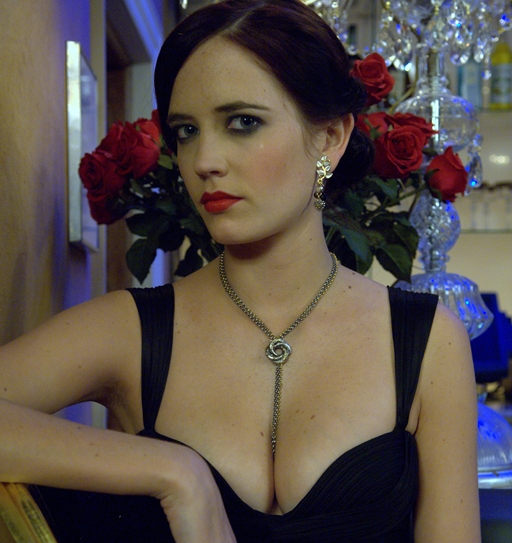
I haven't even gotten to Eva Green's Vesper Lynd yet. She is amazing. Possibly the best Bond girl ever, or at least the most capable and fleshed out. And while we'll get to Bond in a minute, that is probably the most significant difference about this Bond film: the characters actually feel real rather than one-dimensional. This wasn't often the case on previous Bond films, especially when it came to the Bond girl.

Vesper is an intelligent, seductive, complicated, and intriguing character played to perfection by the utterly gorgeous and grossly talented Green who pulls off a real convincing English accent for a Frenchwoman. Her character is complex and there are several layers to the performance that gives her gravitas.

Furthermore, and here's the lemon twist, she has a real impact on the plot of the film, not to mention shaping this James Bond into the man he will become. She is the woman for whom he lowered his guards and who most drastically impacts his life. And she has such an impact since she is his equal, not a disposable sex lady but a woman he can love.

I mentioned she's played by Eva Green, right?

Green is such a fantastic actress that she embodies Vesper with such a seductive reality she is near irresistible and sells every moment on screen. And Craig matches her step for step. I told you that we were getting to Bond and here we are, getting to Bond.

Craig is the best actor to play Bond. While Connery definitely was an iconic actor, that's the thing, he was an iconic actor. He didn't disappear into his characters, you always knew you were watching Sean Connery. He was of those actors that played a type (in this case, suave, sophisticated yet roguish) but played it so goddamn well that it was incorporated into every role he played.

On the other hand, Brosnan is a fine actor but maybe due the scripts he was handed or the direction he was receiving, most of his Bond films require hurt acting when he would thrust out his lower jaw in pain or when he seemed a little stiff in the role on the odd occasion. (I know I'm doing Roger Moore and Timothy Dalton a disservice by not mentioning them but I haven't watched their films so I can't comment.)

But Craig is an actor with some serious acting chops. Perhaps this is why his Bond is the first that feels less like an archetype but a real character with backstory and depth beyond a tuxedo and witty quips.

"Apparently there's a new app called 'Xposition' that provides an easily downloadable backstory to flesh out your character."
 
There are a lot of little nuances in his performance, most of which are conveyed through his eyes, those beautiful baby blues which somehow can express heartbreak and steel up in a second while his face remains stoic. Seriously, watch his eyes. It's all there. The intensity and determination, the rare glance of wry humour, the condensation, the pride.

And that intensity feeds into the way in which he delivers his lines. Now this obviously relates to the scripts he has to work with but Craig's Bond doesn't quip. A line which would have been delivered tongue-in-cheek or a wink by a previous Bond here is delivered as a line someone would say, which actually makes it more effective.

Think about the exchange where Bond is asked by the corrupt MI6 section chief in the black and white prologue how did his contact die, Bond's response is "Not well". Where this would have been delivered with a slight wink at the audience or even a more silly reply like, "He was a little flushed", Craig delivers the line straight giving it more weight, a full-bodied retort rather than throwaway quip.

And talking about full-bodied...

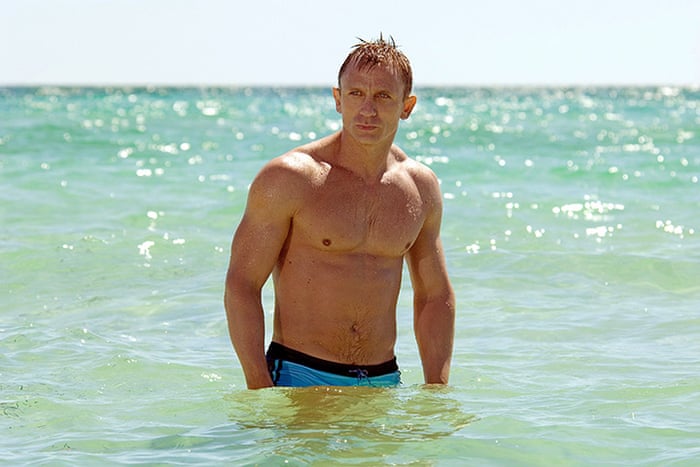
Craig's Bond is physical. More so than any Bond before him. The only Bond I think who could be considered really physical before Craig would be early Connery. And Craig has a great body. This is not to say that previous Bonds weren't fit (although sometimes they weren't, You Only Live Twice Connery) but Craig has a real good body and is in fantastic shape.

The film even comments on his body during the torture scene when Le Chiffre repeatedly swings a heavy knotted rope into Bond's balls. And it is Le Chiffre who makes the comment, right before he starts the worst case of blue balling ever saying, "Wow, you've taken good care of your body". Which he has, he has indeed.

Built like a boxer, this is a man who works out and keeps care of his body through rigorous excercise. I think I might have mentioned on this blog before how there has been a shift in the past 10-15 years to more ripped male bodies on screen, and although Craig isn't ripped, he definitely fits more into this trend than his predecessors.

This isn't to dismiss or body-shame previous Bonds, just to highlight what an impressive body Craig has and shifting ideals of the ideal male form in recent years. Craig is also perhaps the least hairy Bond, at least out of Connery and Brosnan which might be natural or part of this trend, I dunno. Again, this isn't to hair-shame Connery or Brosnan, especially since Brosnan has the most impressively hairy chest.

Dammit, turn down the sex appeal. Jeez.

But I think we should move on to give some measure of relief from the awesome of Casino Royale and shirtless James Bonds, so let's discuss Quantum of Solace, shall we? As a direct sequel to Casino Royale (a rarity for a Bond film), it is often seen as the lesser sibling of Craig's first two outings as Bond.

However, watching them relatively close together, there is a lot to love in Quantum. It's almost like the two films make a great four hour movie if played one after each other, even if the second half isn't as good as the first.

That said, the opening car chase is one of the best car chases put to film. While it is rather chaotic to follow and the editing is frenetic, there is so much well-choreographed exhilaration on screen it's just an impressive action sequence.

I don't think I could adequately caption badassery of this magnitude.

I have to spend a moment here to talk about the theme song by Jack White and Alicia Keys, 'Another Way to Die'. This is generally not regarded as one of the better Bond songs and has actually been quite heavily criticised. And I understand the criticisms mostly because I have no idea what Jack White and Alicia Keys are doing on the same song.

No really, why are they both on the song? The Bond films aren't known for having duets on their theme songs, indeed this is the first Bond theme duet so there is no precedent for two completely unrelated singers with completely different styles singing together on a Bond theme. It doesn't even sound like they were in the same room when they sang their parts. Keys appears to be singing in a different key than White at points and I don't know why it's happening.

It's not even written like a duet where they trade lyrics or parts that have to be sang with two singers. They're just singing together because reasons. It's so obviously a Jack White song I don't know why Keys is even there, not to be mean to her but just out of sheer curiosity.


And all this is a shame because I quite like the song despite it's flaws. I like the horns and White's guitar. I even enjoy the scat-like verses, and appreciate the different set pieces which come in and out like the piano v. guitar bits. Also, it's pretty much in sync with the opening credit's visuals which I always like. For example the first gun shot shoots off perfectly in time with a horn blast following the guitar/drum build up, which is neat.

Now Quantum has its problems, it's lacking in humour for the most part and seems less coherent than Casino Royale, lacking the synergy that movie had. However, it is possibly the artsiest Bond movie, at least of the ones I've seen. There is quite a bit going on here even if it doesn't quite come together.

And now for something completely related, the fight scene at the opera is simply stunning and oh-so-arty. Inter cut with shots from the opera, the sound drops out with some exceptional Foley work that seems dissonant from the action on screen. Guns shoot onscreen and the sound is heard but almost as though it is completely removed from the action even though it happens at the same time. Maybe the sounds are a second delayed? However it was done, it's a great piece of film-making.

Also he looks damn good in a tuxedo he just happened to find in a locker which somehow fits him like a glove.

The plot of Quantum on the other hand less something to be desired. Not because it is terrible but it was really hit by the Writer's Strike back in 2007 and feels oddly disjointed as a result. This is the main contributor to the incoherence I mentioned earlier.

At one point, Bond is in Austria and his funds are frozen because he is suspected of killing the bodyguard of an adviser to the English Prime so he can't pay for a plane ticket to Boliva. Fair enough. Then Bond is in Italy and convincing his ally of sorts Mathis to get him to take Bond to Italy.

Wait, hold up. How did Bond get to Italy? I mean, Austria isn't too far from Italy... if you're travelling by plane or even train but how did Bond makes his way to Mathis' retirement villa? Did he walk there? Did he steal a car?

This is like the cut in The Dark Knight Rises from Bruce Wayne escaping the prison pit somewhere in the Middle East to somehow getting to Gotham city in time. The movie doesn't want you to ask how he got there or how long it took him either. It's just saying he is there now so let's roll with it, okay?

He also had the time to put gasoline on ice and up a massive bridge in the shape of a bat... somehow.

And that segue ways nicely into Skyfall. While making all of the money at the box office on it way to becoming the most successful British film of all time, some people couldn't help but notice that Skyfall seemed to be influenced in part by Christopher Nolan's Dark Knight trilogy.

Which is fitting since The Dark Knight Rises stole its plot from The World Is Not Enough and Chrisotpher Nolan a well-known Bond fan, the whole thing coming full circle with Skyfall cribbing from the success of the Dark Knight Trilogy. Bond films have always taken what is currently popular or in vogue and incorporated it in some measure to the latest Bond film.

The bad guy in Skyfall is definitely supposed to be like Heath Ledger's Joker in The Dark Knight, 20 steps ahead of everyone else, playing off events like a puppet-master. He even allows himself to be capture like the Joker so he can actually lay a trap which makes no sense when you stop to think about the logistics of having your plan hinge on a thousand things you have no control over.

But with hair like that, why would you ever stop to thing about logistics?

Plot problems aside, Skyfall is a fantastic film and definitely is the most gorgeously shot Bond movie. It is utterly stunning how well shot this film is. Judi Dench gives one of her best performances as M which is saying a lot considering that she's a Dame.

M is a strong and forceful character but there's a scene where Silva is threatening M and she is absolutely terrified but trying not to show it and restraining herself. Her fear is only shown in her eyes which give off such a look of outright terror despite her resolve. It is an impressive feat of acting bar none.

And despite his plan riding all on luck or the fact he's omniscient, Javier Bardem's Silva is a great and truly memorable villain. His idiosyncratic manner of talking, his fey mannerisms, homoerotic relationship with Bond, white suits and bleached blonde hair all culminate in Bardem's amazing perrfomance. And his scenes with Craig and Dench are just fabulous to watch.

Thanks for waiting Mr Bond, we were just getting to you.

But back to Bond. I'll say it again, Daniel Craig is the best Bond. The man is great and brought a new physicality, a new vitality, and a new authenticity to the character that none of the previous actors quite managed to do.

I love Connery and Brosnan's Bonds and have nothing against Moore, Lazenby, or Dalton's, but Craig is James Bond.

Even if he is too blonde.

Announcement: 

Musings From Another Star will be on hiatus for a couple of weeks while I battle sharks with lasers attached to their heads. 

But I'll be back after watching my lover suicide-drown herself before my very eyes in order to motivate my character.


References:

Daniel Craig Wikipedia page

Roger Moore on Why Daniel Craig Is the Best James Bond Ever and What 007 Role He’s Dying to Play - Time

Has Daniel Craig eclipsed Sean Connery as James Bond? - The Guardian

Daniel Craig Is Esquire's October Cover Star

My favourite Bond film: Casino Royale


19 Casion Royal (with Matt Gourley) - The Canon

James Bonding #006: Casino Royal with Amanda Lund & Maria Blasucci

James Bonding #004: Quantum of Solace with Emily Gordon

James Bonding #002: Skyfall with Steve Agee

10 Ways Skyfall Borrows From the Dark Knight Playbook

5 Huge Movies That Stole Their Plot from Other Hit Films

6 Huge Movie Plot Twists That Caused Even Bigger Plot Holes

Friday, 18 September 2015

007 Pierce Brosnan: The Bond Is Not Enough

Announcement: This is my 100th Post! Thanks for reading, whether you started with my first ever post about why I never want to see Superman supersweat or with this very post. Hopefully, I'll write 100 more. I hadn't planned anything for my 100th article but this installment of my James Bond series is rather fitting since...


Pierce Brosnan was my James Bond. Other people might have Connery or grown up with Roger Moore, while others still have Timothy Dalton from the late 1980s. I never got into Daniel Craig's Bond since his first Bond film came just as I was entering that age when I thought I was too cool for a film series like Bond.

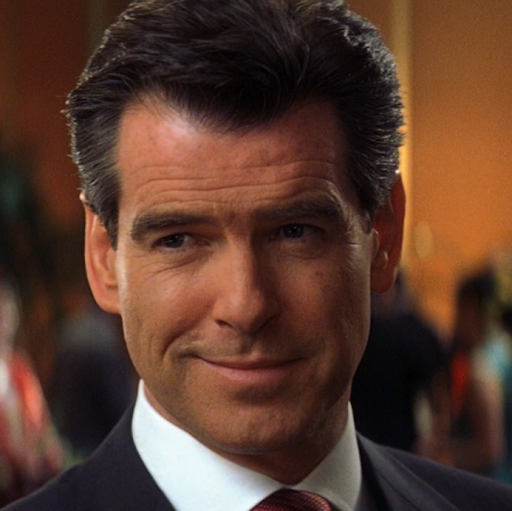
But Brosnan was my Bond. His Bond movies were the Bond movies that I grew up with and can remember watching in the cinema as a child. When I thought of James Bond, I thought of Brosnan.
However, in recent years, Brosnan's tenure as James Bond has gotten a bad rep with his films often criticised as being some of the lesser Bond films and compared unfavourably to Connery, Moore, or even to his successor, Craig. Not as suave or assertive as Connery, as fun and camp as Moore, nor as dark and serious as Craig, Brosnan's Bond is stuck in the middle, caught adrift in that limbo between gritty drama and silly camp, pleasing neither side.

"I'm just deciding whether I'm supposed to be lighthearted or dramatic in this scene, give me a moment."

But it is precisely because Brosnan's Bond encapsulates both the lighter and darker aspects of the series that makes his Bond the definitive James Bond. Connery might have been first, Moore might have been Bond the longest, and Craig may have redefined the character (which we'll discuss next week), but Brosnan's Bond straddled the strange contradictions of the character like no other.

This doesn't mean that Brosnan was the best Bond or that his Bond was perfect, far from it. His Bond films and his performances in them are flawed in some way or another, his later two films more than his first two but we'll get to that. However, Brosnan's James Bond embodied everything that Bond was and is, from the high action and thrilling adventure to the camp ridiculousness and everything in between.

The only Bond partially shaken and then slightly stirred.

This sentiment is shared by Den of Geek's Max Williams in his retrospective review of Brosnan's first outing as Bond, GoldenEye. The first Bond film after a six year hiatus since Dalton's Licence To Kill in 1989, GoldenEye introduced Brosnan as James Bond and reinvigorated the franchise for the 1990s.

Williams notes that in recent years following the critical appreciation of Craig's performance of Bond, Brosnan's own run as Bond has often been dismissed or heavily critiqued for being too slick or lightweight in comparison. Even Brosnan himself has been rather harsh on his Bond performances, stating that he was "was kind of caught somewhere in between the Roger Moore and the Sean Connery of it all".

"Oh god, if anyone makes a 'Stuck in the Middle with Q' joke, that's it, I'm done."

However, that assessment is negative when it should be celebratory. While the shift in gears between Moore and Connery became increasingly jarring, particularly the glorious disaster that is Die Another Day, Brosnan was a good Bond. As Williams states in a direct address to Brosnan,
No offence, Pierce, but hush. You were quite clearly the best Bond since Connery... You had the look, the wit, the killer touch. At your best you could combine the lightness of Moore with the grit of Dalton; the cold heart of Connery hidden beneath Lazenby’s boyish charm. Just because scowls and muscle are currently in vogue doesn’t mean your legacy - certainly as an actor - should be subsequently trashed. Even by you.
And that's precisely the problem. His Bond was such an amalgamation of the different traits of Bond exhibited by previous iterations and performances of the character that Brosnan's take on the iconic spy never stuck out the way his predecessors and successor have.

"Wait, I thought you were celebrating my run as Bond? Did you mention I have a tank?"

Like that kid in class who was good at everything but not great at anything in particular, Brosnan's Bond suffers from the same problem. There's nothing wholly distinctive about him which noticeably differentiates him from the other actors who have taken on the role, leaving him feeling a little bland in contrast.

But that is also his great strength and why he is the definitive Bond. Some may turn to Connery since he is the classic Bond. Or to Craig since he reinvented the character for the 21st century. Or possibly to Moore simply because of his long tenure and the identifiable stamp on the franchise.

But the truth is that there is only one 007 which encapsulates all that is Bond in one package. One man who you can point to if you want show who James Bond is to someone who's never seen a Bond film before and that man is Brosnan. Pierce Brosnan.

"Well, that's nice of you to say so."

And it all starts with 1995's GoldenEye. Now I must admit that while I grew up with his Bond films, this is the one I probably remember the least. I was only around six years old when it came out and I guess it didn't catch my imagination or memory the way his later ones did since I was older.

But rewatching it now, I'm struck by a number of things. Firstly Brosnan seems to just slip into the role of Bond with only the occasional wooden moment in a couple of scenes. Debonair and cool, equipped with a one-liner for every occasion but still vulnerable, his Bond does seem more emotional than Connery's charisma dripping secret agent, not that that's a bad thing.

This is also the introduction of Judi Dench as M, who was my M. And she is fantastic. Simple as that. I also really like Samantha Bond as Miss MoneyPenny. Her flirtatiously charged exchanges and sexual innuendos with Brosnan are great and have a real bounce since the two actors have real chemistry.

James Bond: What would I ever do without you?
Miss Moneypenny: As far as I can remember, James, you've never had me.
Actual dialogue.

What's interesting about this film is that it was the first Bond film in six years and it does acknowledge the fact that the concept of Bond as a character and type of movie may seem outdated to the modern movie going audience. And by acknowledge it, I mean the movie mentions it but doesn't actually address it in any meaningful way.

In her first ever scene in a Bond film, Judi Dench's M gives this biting critique straight to Bond's face,
I think you're a sexist, misogynist dinosaur. A relic of the Cold War, whose boyish charms, though wasted on me, obviously appealed to that young woman I sent out to evaluate you.
Aaaand the movie does nothing to dispute that critique. Brosnan's Bond is a womanising man-whore, whose particular brand of spying does seem to come from another time. But that's part of the appeal since it does have a classic feel to it, updated for the 1990s.

"Wait, aren't you supposed to extinct?"

Another thing is that despite some stunning action sequences, one of the best Bond girl in Natalya Simonova, and a solid script, the film didn't really grab me for some reason. I dunno, but it just didn't do much from me, although I could appreciate it was a good film.

However, I loved Tomorrow Never Dies. I recognise that a lot of that is due to nostalgia. Tomorrow Never Dies is the first Bond film that I can remember watching and I had a lot of fun rewatching it. It did get some criticism for being a bit formulaic, which is a fair critique but I would argue that is one of the film's strengths. It gives you everything you could want in a Bond film.

If Brosnan's Bond is the embodies all the disparate elements in one packaged, then Tomorrow Never Dies is the epitome of Brosnan's run of Bond films for the same reason, having all the elements that other films would have in more or less measure (even the ridiculousness of Die Another Day).

He's driving his car in the back seat with a touch pad on his phone.
I'm just gonna let that sink in.

And that's what is great about it. The juxtaposition of the dramatic moments with the fantastical, the occasionally goofy dialogue and tense exchanges, the amazingly fun camp performance of Jonathan Pryce (who really goes for it here) contrasted with the serious performances of Brosnan and Dench.

It's got everything, including this bit of dialogue I have always remember because of the 'clever' use of the word pump,
M: Your job is to find out whether Carver or someone in his organization sent that ship off course, and why. Use your relationship with Mrs. Carver, if necessary.
James Bond: I doubt if she'll remember me.
M: Remind her. Then pump her for information.
Moneypenny: You'll just have to decide how much pumping is needed, James.
James Bond: If only that were true of you and I, Moneypenny.
Even as a kid I thought that was a bit on the genitalia...

"Truly, terrible double entendres are the worst evil we have had to face in this series."  

Also, it is worth mentioning that Pryce's villain, Ellott Carver, has an evil plan for 'world domination' of media which is completely doomed, even if Bond did nothing to stop him. All it needs is about five years and the rise of the internet. His big plan is to manipulate world events to create news stories for television, radio, and newspapers...

All media which are struggling in the age of the internet, particularly in regards to news. Aside from the whole trying start World War III, his plan seems almost quaint in retrospect completely unaware of the changes that would occur in a short five years or so.

Despite that, it's a rather neat villain plan all things considered. Diabolical, ambitious, and more than a little bit dumb. It's pretty much all you need from a villain's evil plan in a Bond movie. But just watch Pryce's performance in this scene. It is just glorious how deliciously evil he is.


He is obviously having the time of his life playing this character. Every line is delivered with such relish. It makes a stark contrast to the villains in The World Is Not Enough, Brosnan's next outing as James Bond. But before I get to that, I have to address something. The next two films are rough for a shared reason. And that is both have two of the worst, if not the worst, Bond girls ever, Denise Richards' Christmas Jones and Halle Berry's Jinx.

I'll discuss Berry in a bit but Denise Richards is so bad in this movie that she almost ruins the film. Especially since the rest of the actors are so good, putting in some great performances, that it just highlights how flat she is. Brosnan turns in what is probably his best Bond, Dench is fantastic in the first film to give M more to do than give Bond his mission or berate him. But it is the villains who really steal the show.

This guy steal something? Never.
[Note: The following paragraphs contains major spoilers, which are choking hazard. Ages 3 and up.]

Robert Carlyle's Renard is a great villain but in a far more unstated and subtle way than Pryce's exuberantly evil Carver. There's a nuance to his performance and the character of Renard which you don't often find in Bond movies. He is a man with some hurt who ironically can't feel anything due to the bullet pushing its way to his cerebral cortex destroying his senses.

And this nuance comes from his relationship with Sophie Marceau's Elektra King. The film tries a double blind with Elektra, who starts off as a standard damsel to be protected, then it is hinted she might be a bad guy, then it's suggested that maybe possibly she's not a bad guy after all, until it's revealed that "oh no dude, she was totally a bad guy all along".

Elektra was kidnapped by Renard as a child but her father didn't pay the ransom because MI6 doesn't negotiate with terrorists, so Elektra seduced Renard and mutilated herself in order for her father to pay the ransom and free her. And Renard is in love with her but he can't be intimate with her since he can't feel anything. But she also seemed to play Bond against Renard and visa versa, kinda using them both.

All so she could get Bond in her sex neck death chair. 

I particularly remember the moment when Elektra removed her earring to reveal her self-mutilated ear and bringing two thoughts to mind. It's a great reveal with a memorable image but how did James Bond not notice that when Both Marceau and Carlyle are fantastic. But this is the Brosnan film that suffers the most from the jarring juxtaposition from the gravitas of the more dramatic scenes and the ridiculousness of the camp moments.

This really feels like it needed to be a serious Bond film but has too many scenes of silliness and Christmas Jones for it to ever be taken seriously. Which is a shame since it really is a waste of the great characters and backstory developed for the film.

And so we come to Die Another Day...

"Oh god, another vodka martini. Shaken, stirred, I don't care, just get it in me."

I really don't want to talk too much about this film since it is really bad. But let's start with Madonna's title song. It's not good. But it starts well and gets you interested with the string strokes and scorpion percussion but loses it immediately once Madonna begins singing.

Not that there's anything wrong with Madonna's singing but it has been so heavily autotuned for apparently no reason and just ruins any goodwill towards the song. Plus it's the most passively laconic of Bond songs. He will die another day. Since I guess he couldn't get round to it today but it is on his list of things to do.

But the song is a perfect microcosm of the film as a whole. I rather like the more serious opening (discounting the stealth surfing into North Korea of course because why would they stealth surf? Why?). This torture scene and bitter more cynical Bond seems to be in the grittier territory where Craig would eventually take the character. And by all accounts, it seems that's what Brosnan wanted to do with Bond but was never allowed to.

"Eh, whatever. I was the only Bond to have a Jesus beard and look like George Harrison."

Before I go any further, can I mention that I really like the title sequence for Die Another Day? It is probably my favourite Bond title sequence that I've seen so far. There's something about the dancing fire and ice ladies, the intercuts with the torture scenes and crappy CGI scorpions that just hits all the right notes.

And it all goes downhill. Not immediately but very quickly. And it doesn't even feel like Brosnan's first three Bonds which had a similar visual aesthetic with a focus on mainly practical effects and only the occasional CGI, recurring supporting characters, and a more muted colour palette. They were made with two years between each film where Die Another Day was delayed to coincide with the 40th Anniversary, so maybe that accounts for the difference.

And I'm really torn since I can't decide who is the worst Bond girl, Denise Richard's Christmas Jones or Halle Berry's Jinx. I might have to go with Jinx since she has far more screen time and just is terrible. Jones is terrible in the comparison to the strong characters around her but even in the horribleness of Die Another Day, Berry's Jinx manages to stick out. That's an impressive feat.

Berry's awkwardness in these promotional stills speak volumes for how bad her character is in the film proper.
By the way, I'm so glad I found these. She looks like she's never held a knife before in the left picture.

The only thing I can say about the film is that the few moments where it plays it more serious really work. I love the opening, the torture scene, Bond escaping the hospital, getting the key from MI6 and meeting M in the abandon train station where expired agents go to.

Oh, and I have to mention that Rosamund Pike's Miranda Frost is probably the only other good thing in the film. She is great, the only character who seems to have some dimension and is superbly acted by Pike. But any time the film goes fantastical it gets real stupid real quick.

It really shouldn't have been the send off for Pierce Brosnan. He deserved better. He was a good Bond let down by poor scripts, poor directorial choices, an inconsistent tone, and producers who couldn't decide on a vision for the series at the time.

But he will always remain my Bond. The definite Bond.

Stay tuned for the final installment in my series of James Bond articles as I watch Daniel Craig's take on the character for the first time and see what to make of this blonde Bond.


References:


Pierce Brosnan Wikipedia page

James Bond (Pierce Brosnan) 007 Wikia page

BOND 50: THE COMPLETE 22-FILM COLLECTION Blu-ray Review

Pierce Brosnan as James Bond - Reel Film Reviews

Why Pierce Brosnan Was Never Totally Comfortable Playing James Bond - CinemaBlend

Pierce Brosnan on How It All Began—and How Bond Ended - GQ

The name's Bland, not Bond: why Pierce Brosnan is right about his 007 - The Guardian

James Bonding #012: GoldenEye with Craig Rowin

James Bonding #011: Tomorrow Never Dies with Jordan Morris

James Bonding #010: The World Is Not Enough with Derek Miller and Jeremy Smith

James Bonding #008: Die Another Day with Ben Blacker and Ben Acker

Friday, 11 September 2015

007 Sean Connery Part Two: Never Say Bond Again

Last week, I examined Sean Connery's first four James Bond films and how they were kinda sorta rape-y but his captivatingly suave voice and rugged debonair masculinity is so charming, you sorta kinda not-really excuse it. I also discussed the problem Connery had with misogyny, the problem being that he's all for it.

Not wanting to rehash what I've already said, let's move on. This article is gonna focus on the last three Bond films Connery made, 1967's You Only Live Twice, his return in 1971's Diamonds Are Forever, and yes, the bastard prodigal son, 1983's Never Say Never Again.

"I can't believe you would do that."

I actually enjoyed Never Say Never Again, well, at least parts of it but we'll get to that and its illegitimate family-member-we-never-talk-about status in a bit. Let's first provide some backstory for the theme of this article, which is Sean Connery hated James Bond.

Now, obviously he appreciated the fame and financial security the character brought him, seemed to have some admiration for Ian Flemming, and even seemed to enjoy the early films bringing a real freshness to his performances. And that's the thing, it's the first films he did that he enjoyed, not the later ones.

In 1971, as part of the press for Diamonds Are Forever, a Dutch reporter asked Connery which was his favourite of his Bond films so far and Connery answers without any hesitation, From Russia With Love. And hearing his reasons, it makes it clear why he grew disparaging of the character as the films went on:

It had a credibility in the story and was interesting, and the places, and the characters, and the, uh, whole feel of the film, I think. I haven't seen them. I've only seem them all once, so it's a long time now.

I can see what he means. The fire behind him in You Only Live Twice just doesn't seem credible enough to me.

You should hopefully see where this is going, or else I'm terrible at foreshadowing: Connery liked the earlier Bond films since they were 'credible' and didn't require the higher suspension of belief or cartoonish elements that the later films, especially during Roger Moore's run, would have. It's essentially the old "realism vs escapism" argument you often see in discussions about film.

Connery seems to be putting forth the idea that he preferred the 'grit' of his early films to the more elaborate and increasing ridiculousness of the later films, since any film with a character called Pussy Galore can only be taken with the utmost sincerity and credibility.

"Just as credible as my hairpiece."

However, the real crux of Connery's distaste and growing disinterest in the Bond franchise was, at least partially if not largely, due to an issue with negotiation, namely that he never was able to renegotiate his contract. That means he was still getting paid the same fee for Thunderball as he was for Dr. No, despite the fact Thunderball made all the money when it was released in 1965.

Remember this was for the most profitable franchise at the time, with each movie progressively making more and more money than the last. Yet Connery had signed a six movie contract and wasn't allowed to renegotiate his contract for successive films even though the producers continually updated their own contracts accordingly with the growing financial success of the series.

Just imagine a similar scenario today. What if Marvel didn't renegotiate their contract with Robert Downey Jr. for the Iron Man sequels and Avengers films? He would have left after the first film, right? I mean, why wouldn't he? He is the biggest draw in those movies, the star everyone is coming to see. His personality and popularity are central to the success of those films, films which have made so much money that they had to come with new adjectives to describe how much money they made. A goddamnshitonne is one.

"Awww, that's adorable. They think they'll have a franchise without me."

Connery was in Downey's position back in the 1960s but instead of having any leverage or ability to dictate the terms of his contract as the series went on, Connery was forced to accept the same pay regardless of how well the films did. Conversely, Downey is one of the highest, if not the highest, paid actors in Hollywood right now precisely because he has been able to renegotiate.

So obviously this contract and not making the money owed to him thing seems to have made Connery a bit bitter about his experience with Bond and that bitterness filters through in his performances. With each subsequent film, he displays less and less interest in being there until he's barely hiding his near contempt and disinterest by the time we get to Diamonds Are Forever.

And we'll get there but first let's talk about You Only Live Twice, the last film in Connery's initial five film run before George Lazenby's turn in On Her Majesty's Secret Service and his return in Diamonds. Connery isn't bored yet but he does seem a little complacent, possibly since this is a role he's played so many times before that he can't invest in the character any more.

Maybe it was the yellow-face because we are gonna talk about the yellow-face.

Now before we go any further, we have to talk about the yellow-face in the film since Connery turns Japanese in order to go undercover in a small Japanese island village so he won't be noticed by the locals or somethings and has to get married to a Japanese girl as well, because reasons.

Let's recall that Sean Connery is a 6 foot 2 Scotsman who is so obviously a 6 foot 2 Scotsman that he can only ever be a 6 foot 2 Scotsman. He was even a 6 foot 2 Scotsman when he played a Spaniard in Highlander and a Russian in The Hunt for Red October. He was still a 6 foot 2 Scotsman when he voiced dragon in Dragonheart. The man cannot be anything other than what he is.

Which is a 6 foot 2 Scotsman.

Pictured: Sean Connery. Seen here being 6 foot 2 and Scottish.

Suffice to say that even after his Japanese make-over, which really just consists of some eye make up, a chest waxing, thicker eyebrows, and a new bowl cut hair piece, nobody is ever going to confuse this 6 foot 2 Scotsman for a Japanese villager.

No matter how desperately Connery hunches his back to appear shorter, he's still a good head taller than everyone else and so transparently foreign, it makes this part of the plot seem completely superfluous since there is no way anyone's supension of disbelief would be able to believe that anyone in the village will look at yellow-face Bond and go, "why that stranger is so Japanese he must be from the inland which is why I don't recognise him, so Japanese is he".

And I know that is a film with a villain lair inside a hollow volcano so they are stretching the realms of what is believable but this is about what could conceivably exist or happen in the fictional and there is no way anyone could possibly fall for Bond's yellow-face 'disguise'.

Plus it's yellow-face. I don't want to dwell on race in the film since I think the Bond's first lines in the film accurately highlight how well the movie handles Asian culture. With the utmost respect and sensitivity, of course.


However, what I want to focus on is how Connery just sort of mumbles his lines without much conviction, with little of the zest he initially gave the character in Dr. No or especially From Russia with Love. There no much vitality here, perhaps a severe cause of senioritis.

This doesn't mean it is a terrible performance by any means, Connery is still as charming as ever, how could he not be with a voice so suave it comes served with a martini, but he is on cruise control here. Just rewatch that video up there. Whereas in previous films there would be a twinkle in his eye as he delivered that 'flirtatious' dialogue, here's he's nonchalant as hell.

But that voice though. Even when he's on autopilot, it's such a smooth ride, it almost doesn't matter. With such syrupy chocolate for your ears and rare manbeef for your eyes, it's kinda okay that he's not really trying. Because he's really not. He's been here before, got the t-shirt, wore the t-shirt a few times before the print faded in the wash, and now just kept wearing it even though the fabric's getting worn through.

"I do die in this one only to come back so maybe it's fitting my performance feels like a disengaged zombie."

But it's in Diamonds Are Forever where Connery's autopilot turns into complete disinterest. He couldn't be less there if he tried. He is so disengaged from what is going on around him that he barely emotes anything besides what I assume is apathy for having to wear such a terrible toupee. On Connery's performance, The Guardian's Xan Brooks notes,
Connery clearly does not want to be there. He shuffles through the motions like some ageing heavyweight showboater, flirting with disaster, his toupee slipping.
Perhaps I and Brooks are being a little harsh (and are somewhat fixated on his awful toupee), but Connery does sorta kinda totally sleepwalk through most of his performance in the film. That is, aside from the moments of violence, that he seems all for, particularly in the opening scene when he strangles a woman for information - with her own bikini top...

No, I'm serious. He literally says the words, "there's something I want you to get off your chest", rips off her bikini top and proceeds to strangle her with it, all the while interrogating her for the whereabouts of the big bad, Ernst Starvo Blofeld.

On a separate note, this is the only time we see him smile in the whole film.

This probably why the scene in which Connery has the most energy and actually seems to give a shit, is the elevator fight scene, one of the classic claustrophobic choreographed fight sequences in Bond films, following in the tradition set by the amazing train compartment fight in From Russia with Love.

At the end of the fight, Bond puts his wallet in the dead man's jacket so he will be mistaken for James Bond, which is actually an inspired piece of screenwriting as it seems like a real clever decision made in a split second that a spy like James Bond would do.

However, pay attention to how Connery responds after Tiffany Case declares he killed James Bond. With less conviction than a skunk trying to deny he dealt it, Connery responds, "Is that who he is?" as convincingly as that kid who did theatre but was always cast as a tree in the school play, even when there were no trees in the script.

In unrelated news, we get to see Connery's ripped spy bod.

Can we spare a moment here to discuss how Diamonds Are Forever is bonkers? Like really. The movie is all over the place, at times the score just drops out, there are so many great camp moments with utterly puzzling lines, mostly from Tiffany Case (notably, "Blow it up your pants"), and the plot is mindless in the best possible way.

However, it has two of the greatest henchmen characters in Bond history, Mr. Kidd and Mr. Wint. Played by Putter Smith and Bruce "father of Crispin" Glover respectively, they are the ambiguously gay duo set out to assassinate people who are part of a diamond smuggling ring to cut any loose ends or something. It doesn't matter.

What does matter is they are amazing. Glover wildly overacts with delicious glee while Smith, not a professional actor by trade, struggles not to break character at points and underacts, creating a perfect yin yang of acting extremes that underscores their characters otherness. They're great.

"Being ambiguously gay while committing murder is tiring work, wouldn't you say, Mr. Kidd?"

And that brings us to Never Say Never Again, the unofficial Bond film Connery made in 1983, directed by Irvin Kersher, fresh off Star Wars Episode V: The Empire Strikes Back. Now the story of Never Say Never Again is one of copyright, intellectual property, and lawsuits. To make a long story fit in a martini glass, back in the 1950s, Ian Flemming had worked with a man called Kevin McClory on the screenplay for what would eventually become Thunderball, which Flemming then turned into the novel.

Later when they wanted to turn into a movie they struck a deal with McClory, who had some intellectual property rights on various aspects of the story such as the secret terrorist organisation S.P.E.C.T.R.E, to be an executive producer on the film on the condition he wouldn't make his own film version of Thunderball for 10 years.

10 years passed and he wanted to make his own adaptation of the script. Legal battles ensued until a judged ruled that he could indeed make his own film version which became Never Say Never Again, which is one of the non-canonical entries of Bond on film. End of backstory.

It's so non-canonical Mr. Bean is in this one.

Despite the early eighties touches and illegitimate status, it's actually a rather fun movie and quite entertaining. In his fifties, Connery plays an aging Bond who has to prove he still is capable of being a spy in his advancing years. And honestly, he gives off a pretty good performance, showing why he is often consider the best Bond.

While he is overly comfortable in the role, he doesn't sleepwalk here like he did in Diamonds Are Forever and actually seems to be in better shape than he was back in You Only Live Twice, 16 years prior. He actually seems to have some twinkle in his eye when sprouting cringeworthy pun-laden one liners.

Also, the fact so much of the movie revolves around his age and whether he should still be a spy, adds to the performance I think since there's an element of the character mirroring the actor or visa versa. Although somehow his toupee is even worse in this film. I don't know why hair piece technology seemed to regressed in the 12 years since he last played Bond before this film, but it had.

It just had.

Stay tuned next week when we take on Pierce Brosnan's dashingly bland series of Bond films where I think he was a good James Bond tragically stuck in terrible Bond movies.


References:

Sean Connery Wikipedia page


Sean Connery on The Tonight Show with Johnny Carson, 1983 - The 007 Dossier


My favourite Bond film: Diamonds Are Forever - The Guardian

Sean Connery interview 1971 on James Bond & behind the scenes Diamonds Are Forever