Friday, 15 July 2016

007 Announcement - The Second James Bond Month

Dundedun dun dun dun dundedun dun dun dun 


Welcome to the second edition of James Bond month. I'll be taking a short hiatus for research but Friday the 5th of August will see the first of three, yes, that's right, three articles covering the Roger Moore era of Bond.

The second James Bond Month will be capped by a post looking at the black sheep of the Bond franchise, covering George Lazenby's single outing as the world's most famous secret agent and Timothy Dalton's two missions in the late 1980s.

This is gonna be interesting since I haven't seen a lot of these films and don't entirely know what to expect aside from the casual misogyny, fancy gadgets, and outlandish adventures of course.


Friday, 8 July 2016

Family Ties in Legend of Korra - Book 2

Book 2 is often seen as the weakest season of Legend of Korra with some valid reasons. While it's not really the goal of this series of posts to examine the narrative or other elements of the show but rather to focus on the interpersonal relationships, I do want to address those critiques of Korra's second season and defend it a little.

Now, this might not be a popular opinion but I actually like Book 2 over Book 1. When I rewatched it, I noticed there was a lot more to be mined from a rewatch than when I watched Book 1 again. A lot of this has to do with the deepening relationships between the characters which I'll get into but also because Book 2 has some simply amazing moments.


The problem is that is an uneven season. The writers had written themselves into a bit of a corner with the end of Book 1 (since they didn't know they would get a second season) and started the season seeming with a number of interesting ideas, half of which they never explored.

They also had to dial back some of Korra's character development in the beginning of Book 2 becase of how they worked themselves into that corner, although as I have argued before
this is how real people behave. We expect and want our fictional characters to grow and develop, learning from their mistakes and developing, but often people in the real world don't. Not because they don't want to or can't, but because change is hard and habits of behaviour are difficult to break.
I understand that this a bit of honeypot on my part, trying to explain away a flaw in the writing but I still stand by it to some degree. Honestly on the rewatch, while Korra does appear to be just as brash as she was in the first season and reacts to things in a confrontational way, most of the time she is justified in the way she feels, if not in her reaction.

"My father and my mentor purposely lied to me because of their overprotective paternal desire to 'keep me safe' despite the fact I'm the Avatar, while my boyfriend is seemingly supportive but passive aggressively undermines me due to his own ego issues.
So yes, I'm a little pissed, why'd you ask?"

Korra is frustrated at the sense of betrayal and lack of trust from the father figures in her life who are more concerned with controlling or shielding her in the name of keeping her safe than they are about letting her become her own person.

Korra had spent her whole life up to this point believing that Avatar Aang had decided it was best for her to live and train isolated in the Southern Water Tribe with the White Lotus but learns it was actually her father and Tenzin who made the call.

Add to this her frustration at her inability to develop spiritually is misdirected at Tenzin's teachings, it is no wonder that she responds positively to the first male authority figure in her life who tells her that he has faith in her and treats her as an adult instead of a child that he must shield from the world.

The fact Korra doesn't pick up that he is totally evil from the first second she meets him is understandable in those circumstances.

People forget but Korra is around 18 at the time of Book 2, she's a young adult who wants to establish her own identity but feels as though she is still treated like a child by the men in her life, especially by her father. In that context, while she definitely reacts far too angrily at times, there is a real cause behind those emotions that I think is often dismissed.

Most criticisms of Book 2 revolve around the retread of character developments from Book 1, Tumblr blogger beccatoria argues that the show repeats those beats to first deconstruct and then reform them,
"The latter half of the series began to rebuild itself in new and fascinating ways, but it was here that the series made a radical, handbrake turn. This was where Korra’s queer origin and radical future were expressly clarified."
For the second season is when the interpersonal relationships and familial drama between characters becomes incredibly intertwined and complex. The foundations of those relationships were laid in the first season but Book 2 steps it up massively.

Now it doesn't always work and the narrative occasionally presents some unintentionally problematic relationships without realising it (which we'll get to), but when it gets it right, it is some of the most touching and effective storytelling on television.

Pictured here.

I'm sorry but every scene with Tenzin's family and his siblings Bumi and Kya is golden. While other aspects of the story might have been uneven or even annoying (like the incompetent dumb detectives who were supposed to be foils to Mako), the fact that Book 2 had the familial drama of Tenzin's siblings more than balances out the missteps elsewhere.

There is so much to get into that it's hard to know where to start but I suppose a good place is with Aang. Aang, the beloved bald protagonist of The Last Airbender, wasn't a good father. He wasn't a terrible father but he wasn't there for all his children the way a good father is. And that is important.

It's a nice deconstruction of the idealisation of fatherhood, which is an important narrative to tell. Not in a "I never knew my father!" way, or even in villainous "he was an arsehole" way, but rather showing that although Aang was the protagonist of the previous season, he had aspects of his personality that didn't make for a great father.

Which was a bold move for the writers to make simply because of how much Aang was as a character, not to mention as the hero of the previous series. It would have been easy for them to depict Aang as a perfect dad. But his failures as a father are clear in the obvious favouritism he had towards Tenzin as his only child who could airbend, something which caused lingering resentment from Bumi and Kya.

Pictured here.

This isn't mentioning just how heavy Aang's legacy as the Avatar weighs down on his children. It affects each of his children but let's spare a tear for Bumi. As Aang's oldest child he felt a massive responsibility to uphold his father's legacy but as a non-bender he felt he let his father down.

I think LoK Gifs & Musings put this better than I ever could so I'll just quote her here,
"Bumi may well be one of the most tragic characters in the show. Though Aang and Katara likely wanted children, I’m sure given Aang’s status as the last airbender, they also felt a great responsibility to do so. Though I am sure Aang or Katara loved Bumi, the fact that their eldest was a nonbender had to have been a bit of a blow for them. And even though they seemed to let Bumi be free to follow his own passions (joining the military and drinking a lot of cactus juice, from what I can tell), there was a part of him that internalized the guilt of not being “enough” for his parents." 
Bumi's juvenile behaviour (especially for a man into his 60s) is his way of standing out even though he can't bend. Considering both his siblings are benders and formed bonds with their parents that he couldn't, it's no wonder he plays the clown to mask the internal sense of inadequacy he feels.

All of which is crystalises in the scene where Bumi talks to Aan's stature.

"Uh, hey there, dad. You're looking well.. Look, I'm sorry I didn't turn out to be an airbender like you hoped, but I've tried my best to make the world safe. Hope I made you proud." - Actual, heartbreaking, dialogue.

I think we have to move on to Tenzin now. Tenzin may be Aang and Katara's youngest child but as the only airbender, he felt a particular responsibility to uphold his father's legacy, even more so than Bumi.

Tenzin was so dedicated to preserving Aang's legacy as the Avatar that he created an idealisation of his father which glossed over Aang's real flaws as a parent. Also, this dedication meant he focused all his attention on being like his father instead of accepting that he is his father's son, not his father.

I don't want to go into this too much since LoK Gifs & Musings basically covered everything I want to say in her "I Am Tenzin" article. The only thing I will say is how Tenzin's journey to let go of his internalised guilt as a failed spiritual leader is combined with learning to let his daughter Jinora come into her own as the spiritual leader he couldn't be is something else. He escapes the spectre of his father at the same time that he, as a father, allows his own child to grow.

Awww...

I don't want to seem like I'm neglecting Kya but she isn't given as much attention in the narrative as her brothers. That said, she has to deal with the emotional baggage of their less than ideal childhood as well and actually seems the most bitter of the siblings despite her empathetic caring nature.

For example, she is the one who snaps at Tenzin for idealising their father. While Bumi was definitely upset by the special attention Aang gave Tenzin, Kya seems genuinely hurt by it and became defensive as a result.

She tried to escape her family's legacy in her youth, travelling across the world while Bumi joined the military and Tenzin join the council in Republic City. However, she then went back to the Southern Water Tribe to look after their elderly mother after Aang died, which is something she chastises her brothers for failing to do.

On the other hand, after Bumi has his confessional moment talking to Aang's statue wondering if his father would be proud of him, Kya overhears and immediately says that of course Aang would be proud. She then gives him a hug as Bumi tells her she always knows when he needs one. It's a touching moment.

Sibling huggery.

Jumping back to Tenzin for a second, in light of the emotional journey that he goes through over the course the season  it's not surprising how constricting he is as Korra's teacher in the beginning of Book 2 and why she bristles against that.

I covered in my previous Korra post how the differences in their personalities make them the perfect teacher/student combination but only by adapting to each other. Now, although I can totally see where Korra is coming from, at times the anger she flashes at Tenzin seems unfair in light of his transgressions.

Regardless, their reunion in the second half of Book 2 and the fruition of their relationship as it blossoms by the end of the season is completely worth the (only) slightly contrived nature of their parting of ways in the beginning of the season.

Did I mention that Tenzin is the one who helps Korra complete her spiritual journey?
With hugs!

But before we celebrate the wonderfulness that is the familial drama of Tenzin's family and the blossoming of his relationship with Korra, I mentioned there were some problematic relationships in this season, so let's look at the most problematic - Bolin and his love interests, Eska and Ginger.

There's no other way to say this, Bolin is in an abusive relationship with Eska. She forces him to do things he doesn't want through intimidation, fear, and the threat of violence, isn't interested in his well-being, only in how he can better serve her. He isn't her boyfriend, he's her victim.

And yet the show presents this as something funny in a 'Oh, look at how Bolin can't get out of this abusive relationship, isn't it hilarious how Eska, a girl, dominates him and he just whimpers?' way. It's not like they ever examine the destructive nature of their relationship in a meaningful way, it's only depicted as a gag.

The fact they immediately follow this up by having Bolin sexually harass his co-worker Ginger on the set of their movers (old-timey film reels) is rather tone deaf, especially for a show that gets so many other things so right.

And let's be clear, Bolin is sexually harassing her. They're at their workplace, she told him that she wasn't interested and that he is confusing "Ginger the actress with Ginger the character" but he still continues to flirt inappropriately and make unwanted advances.

The difference between their facial expressions says it all.

And so we come to Mako and Korra. I discussed before how their relationship had a sense of contrivance to it since there never seemed to be any reason for them to get together aside from the fact that they were the male and female protagonists.

However, there is a lot wrong with Mako's behaviour and how he treats Korra that I didn't notice until this rewatch. The reason I didn't notice it the first time around was that I used to be a lot like Mako in terms of the type of boyfriend he is.

Therefore, I didn't see anything wrong with his actions despite the fact that they are only superficially supportive and actually quite defensive in nature. For example,
Korra: What do you think I should do?
Mako: I guess you should do what you think is right. I support whatever decision you make.
Korra: Oh thanks. That’s a big help.
Mako: I thought you wanted me to be supportive? Now you want me to tell you what I think? Make up your mind!
Korra: Just forget it.
I originally sided with Mako in this argument because it hit home with what I would likely would have said in the same position but then I realised that he isn't being supportive by withholding his opinion, he's avoiding conflict. Korra expressively asked him for advice and his response was to give an empty declaration of support for fear of her disapproval.

Like Mako, I wanted to place myself as the protector and feel useful to, or even needed by, the person I was with. This is something that's subsided now and I don't feel that same need to be a 'protector'. because I figured it's not necessary, and even more than that, it's infantilizing. If you see your partner as someone who needs to be protected constantly, you're not treating them as an equal but like a child in your care.

She really doesn't need anyone's protection.

However, I didn't have the same anxiety Mako has in regards to being dominated by Korra since I came more from a "white knight" place and didn't feel threatened by the accomplishments of my partner. Because Mako's ego does bristle at the fact Korra is the Avatar, with more responsibility and power than he will ever have.

At one point before their break up, Korra apologizes to Mako for her inconsistent behaviour and blowing up with him due to the stresses of her role as the world's protector,
Korra: By the way, I'm really sorry for being a total pain. Things were really stressful and pretty confusing. It's hard being the Avatar.
Mako: (jokingly) It’s harder being the Avatar’s boyfriend.
Mmmhmm, really? It's harder being the boyfriend of the most powerful person on the planet with the weight of innumerable political, social, spiritual, military pressures than being that person? I know, Mako's cracking a joke here but it does seem to indicate where his head's at.

I mean, he doesn't offer any substantial response or support to address the stress that Korra's feeling, he just makes a joke about how hard things are for him.

"Yeeeaah... not quite the supportive response I needed there, Mako." - Korra, probably.

So yeah, its't not at all surprising that once they get back to Republic City and Mako is able to go back to his job as a police officer that even his pretense of support for Korra kinda evaporates. It's like as soon he is back into his role as a 'protector' in an official capacity, he's freed himself from having to support Korra.

He practically blames her for the civil war between the Water Tribes even though in the previous episode he helped her break her father out of prison, an inciting incident for the war in the first place. After Korra visits the President of Republic City to ask for his help in the war and he refuses, she complains to Mako who agrees with the President.

He eventually betrays Korra's plan to get the Republic fleet without the President's permission which leads to their breakup. All because he felt his job was more important than their relationship due to the insecurity he felt at being 'dominated' by Korra. While he loved her as a person, he couldn't accept her role as the Avatar.

This is more obvious when later in the season he is willing to risk his job to be a protector for Asami, setting up a sting mission without proper approval. Unlike with Korra, Mako doesn't feel threatened by Asami's power (she is a wealthy industrialist after all) in the same way and therefore doesn't need to hold on to his official police officer role as 'protector' with her.

To be fair to Mako, I would want to protect Asami as well if she looked at me like this.
Then I remember that she is a highly intelligent and capable person who holds her own in a team of benders.

In regards to the whole Mako/Korra thing, I'm glad they showed the dissolution of their relationship. It really seems like a deconstruction of the 'inevitability' of them getting together in Book 1 simply because they were the male and female protagonists and highlighted why they shouldn't be a couple.

I'm going to have to end it here but again there were things I didn't get to touch on, like the retread of brother vs brother with Unalaq and Tonraq, Korra's relationship with her parents, the dynamics of Tenzin's children, or Bolin and Asami's wonderful bromance.

This gif is everything.

Oh, well. Maybe next time.

Book 3 in this series will come out whenever I manage to finish the season. I should probably get on to that.

References:

The Legend of Korra: Deliberately Deconstructed - beccatoria

Korra's Relationships - Avatar Wiki

Bolin's Relationships - Avatar Wiki

Meta: Mako’s Castration Anxiety - LoK Gifs & Musings

Bumi, Kya, and Tenzin: Analysis - LoK Gifs & Musings

I Am Tenzin - LoK Gifs & Musings


Friday, 1 July 2016

The Anatomy of a Fight Scene

Fight scenes are often maligned as dumb bits of action with little intellectual or thematic worth. I mean, there's a reason why action movies aren't often considered films that say something or have little artistic merit.

To be fair to that critique, most action movies, while enjoyable on a visceral level, don't have much to say about the human experience but then the same could be said of most genres. More often than not, their goal isn't to make a profound comment on the meaning of life but rather to entertain, which is valid aspiration in its own right.

However, the value of action movies not really what I want to focus on. Instead, I want to examine what makes some fight scenes work and others not. There's an art in choreographing the perfect fight scene and what needs to go into giving that fight scene weight. For example, a fight scene might look great but feel hollow or another might look simple yet be completely engaging.


Let's start with Star Wars, a very good place to start. Okay, I'm going to real here for a second, speaking purely in terms of action and the choreography, this scene is simply boring. There's nothing visually interesting and the lightsaber "battle" is just a bunch of old guys tapping glow-sticks at each other while talking.

However, this scene is often praised over the complicated flippy twirling battles in the dreaded Prequels where Jedi are bouncing here and there and everywhere with back-flips and Force aided acrobatics. That doesn't make sense, right? Surely, the more visually stimulating an action scene, the better? Not if those visuals don't have any meaning to them.

In the clip above, while it is is rather restrained visually, there is so much narrative and thematic weight to the fight that it feels more far more epic than it actually is. Through the dialogue you get the backstory of Obi-Wan and Darth Vader which frames their fight as a confrontation between former friends who were once in a master-student relationship. The fight has meaning, which is why,

Hmm, Obi-Wan didn't do a back flip in this one?

People remember that fight fondly because it had consequence. It also had a purpose within the narrative since it ended with the death of Obi-Wan, an act which was needed for Luke's character development and the fulfillment of his hero's journey.

As Tumblr blogger meddlingwithdragons puts it,
“A fight is conversation. With stabbing. But still, it’s communication. You’re supposed to learn things about people in the fight. And not just oooo shiny swords moving.”
This comes through in the fight with Obi-Wan and Darth Vader. You see the dynamic at play between them, not only through their dialogue but through their fighting styles and the type of fight they're having.

They're older men and their movements are slowed by age but Obi-Wan favours parries and controlled stabs to Darth Vader's more forceful thrusts and slashes. This mirrors their different personalities and perspectives - it actually says something about their character ans what this fight means to both men and the story as a whole.

And then we get this,

What is this even?

The Yoda versus Count Dooku fight in Attack of the Clones is one of those things which seems like a good idea at the time and is kinda fun while you're doing it but immediately regret afterwards when you think about it for more than two seconds.

Now, I don't want to harsh on the Prequels since that is a dead horse which has been well and truly beaten to a pasty mulch but let's just examine that scene for a moment in contract to the Obi-Wan versus Darth Vader one just discussed.

The scene opens after Dooku has easily defeated young Obi-Wan and Anakin. Yoda walks in all boss-like and Dooku starts throwing things at him with the Force, including some CGI lightning which hasn't aged that well, which Yoda deflects. Dooku then declares they must settle this by their skills with a lightsaber and so they fight.

And by fight, I mean, Yoda jumps around flipping this way and that while Dooku twirls his lightsaber around, both occasionally hitting the other but missing just as much (see above gif). There's absolutely no wait to this fight. Yoda is a CGI Muppet and it shows that Dooku is fighting something that isn't really there.

Just in case you missed it.

Also, Yoda tells Dooku that he has fought well and drops the bombshell that he was once his Padawan - near the end of the fight, undercutting any impact that revelation might have had during the fight itself since it's after the fact. And the Dooku bounces out of there.

It's obvious that they were trying to recall the whole student gone dark versus wise master thing but it just falls flat. I might have blocked large parts of Attack of the Clones from my memory but I don't think Yoda or Dooku have ever mentioned each other before this.

In A New Hope, one of the first things Obi-Wan does is give Luke some backstory (later retconned in Return of the Jedi) about how his father was betrayed by a former pupil of his who was seduced by the dark side of the Force, Darth Vader. So when they face off later in the movie, you understand the history between the characters.

"I didn't even mention that time your father and I fought on a lava moon and I chopped off his limbs, leaving him to die."

But the Yoda/Dooku fight doesn't even work with the choreography for the scene. Yoda's spastic twirling and hyperactive jumping don't really lend the fight the gravitas which would match the type of emotional beat they're trying to go for. Furthermore, the editing continually cuts away to hide the imperfections in the fight or changes to a close up when their lightsabers engage so you don't notice the Christopher Lee's stunt double or the average CGI.

This is supposed to be a fight between a master confronting an old student who has betrayed his teachings. However, all I see is an old guy in a cape randomly swinging a red laser sword at a jumping frog-thing with a green laser sword. The only thing that makes this feel epic is the music, which hits the intense tone just right. Too bad the fight itself feels empty.

Staying with Star Wars, because why wouldn't we stay with Star Wars, I want to contrast that fight to Rey and Kylo Ren's lightsaber battle at the end of The Force Awakens. There's no way I can contain my enthusiasm for how much I love this scene but I'll do my best.


Firstly, the cinematography and lighting is just brilliant. Each shot is frame perfectly and gives you the full sense of the fight with no tricky editing to disguise or hide mishits. It's nearly all shot in long shot or medium shot, with close ups only used for a purpose (which we'll get to).

And each swing of the lightsaber had substance to it. In the Prequels, a big problem was that lightsabers were swung as they had no physical weight, like a glowing plastic sword. When lightsabers clashed in those movies, there was no oomph behind that clash, it might as well have been two pillows smacking into each other.

But in this fight a lightsaber seems physically heavy and when they clash there is a real collision there. Rey and Kylo Ren don't jump around each other light as a feather, they swing their lightsabers with some exertion. This isn't an easy thing and it feels like they are wielding supremely dangerous weapons. Each blow seems heavy and packs a punch.

And then there are the close ups. remember I said we'll get to them? Most of the fight is shot in medium or long shot, framing the fight in camera with no tricky editing. The only real time we get a close up is of Rey's face where Kylo Ren has her pinned and says she needs a teacher to learn about the Force. She then closes her eyes and opens herself up to the Force (something she had been actively rejecting), turning the tide of the battle.

This is not the face of a woman who was losing this fight a few seconds before. 

We also see Kylo Ren's face in close up as he watches this transformation with some puzzlement, not realising he had inadvertently given Rey the means to defeat him. My point is that these close ups had a point and served to show what each character was going through emotionally.


Not to mention that the setting of the dark snowy forest is inspired and just lets the heavy blue and bright red of their lightsabers really stand out. The fact that the planet is coming apart forming gigantic caverns is something else, I know this isn't the most original visual metaphor for the destructive forces at play in their fight but the way it actually ends the battle with one of them on each side of a gigantic cavern creates a striking visual which is quite effective.

This fight is not only epic, it feels mythic, like something from an old legend. The duality of dark and light, the wonderful choreography, the forest setting on a planet falling apart, the dynamic at play between Rey and Kylo Ren. It's just beautifully done.

Speaking of things, which are beautifully done, let's leave a galaxy far, far away to talk about Daredevil.


In this scene, instead of being an invincible badass, we see Daredevil getting tired as the fight wears on. He has to catch his breath after dispatching bad guys, pausing before going to the next one, his punches getting looser, arms heavier. By the end of the fight, he can barely walk into the room where the child was being held captive but forces himself to. It feels real in a way so few fight scenes are. And it is expertly crafted.

Daredevil was actually why I wanted to write about fight scenes in the first place. The fight scenes in Daredevil are impeccable, just everything you could want in a fight scene. So much so that I looked up who was the stunt coordinator for the show which isn't something I think I've ever done before.

His name is Philip Silvera, by the way, and he also did the stunts for Deadpool, which were great for the complete opposite reason to Daredevil, over the top and hilarious opposed to brutal and realistic. Eschewing the wire martial arts which has been in vogue since The Matrix and Crouching Tiger, Hidden Dragon, the choreography on Daredevil emphasises fatigue and vulnerability with hits that have real oomph behind them.

And they are designed to serve the story. In Silvera's own words,
"I hate repeating the same story or telling the same story. The stairwell fight that everybody's talking about, it's the one shot fight on crack. I like to think it's its own, it's its own piece right now. Not trying to do what we did last season 'cause that was unique to that story and I think this one is unique to this story."
Because a good fight scene helps tell the story. Here's that stairwell scene he's referring to:


I'm sorry but that is possibly the most impressive fight scene I've seen in years, definitely among the best ever on television. That's a five minute fight in a single take tracking along as it moves down a stairwell. I can't imagine the amount of planning and practice it took into bringing that fight to the screen since everything needed to be thought out and executed perfectly. They didn't have cuts to hide behind.

It also tells a different story than the hallway fight from the previous season. That Daredevil was still inexperienced and learning, only half-healed after an ambush. The hallway scene was supposed to emphasise his determination and grit, not refusing to stop even though his body ached.

The stairwell scene showcases an older and more confident Daredevil. He has full command of the environment around him. He even uses what could have been a handicap (his one hand has a chain wrapped around it while his other hand has an empty gun duck-taped to it) as an asset.

The fight is still difficult and tiring (he's exhausted by the time he gets down the stairs) but shows how far he has come as a fighter while still highlighting that his determination to keep fighting despite the odds hasn't wavered.

There's a reason "daredevil fight choreography is the third auto-complete search term if you Google "action choreography".
Fight scenes shouldn't just be guys punching each other or swinging swords with no point aside from looking cool. They should tell a story and reveal something about the characters.

A fight is a conversation, so it should say something. It's speaking with punches and swords.


References:

A few thoughts on GoT’s fight scenes - turtle-paced

Daredevil: Exclusive Behind-the-Scenes Fight Footage

Philip Silvera IMDb page

Friday, 17 June 2016

What's in a Theme?

Let's talk about theme songs. They open our favourite television shows at the start of each episode, we hear them week after week. The pieces of music or songs which tell you something about the show you're about to watch, they are an often overlooked part of a show's success.

You can't think about Cheers without starting to hum "where everybody knows your name" or start an episode of Friends without wanting to clap in time with The Rembrandts' "I'll Be There For You". It's just not physically possible. Those songs are so intrinsically and inescapably linked to their associated television shows that hearing them immediately brings nostalgia tinged recollections of the show.

Funnily enough, it seems to me that often the song can be even more memorable than the show itself. I know chorus to "Where Everybody Knows Your Name" so well that hearing it is like meeting a good friend, warm and familiar.


And this is for a show I can barely remember. To be fair, it was popular before my time but I still didn't watch the show regularly, at least not that I can recall. Despite that, the song remains entrenched in my mind. It's more than just having a catchy hook or singalong chorus though. The song is wrapped in the 'feel' or essence of Cheers.

And people love the theme songs to their favourite TV shows and recall them fondly. If you type in "tv theme songs" into Google, you are immediately bombarded by lists of the best theme songs defining what makes a good theme.

This was just as much as I could catch in one screenshot. The lists go on and on and on. They never stop...

Which is something that interests me. How does a piece of music which is so intertwined with a show become so memorable that ir can actually surpass the show in regards to popularity?

I think part of this of course has to do with the fact that songs are significantly more transportable than a television show. What I mean by this is that a song can be recalled far easier than an episode or series. A drama is an hour of television while sitcom is between 22-25 minutes long and cartoon like Adventure Time or Steven Universe is 11 minutes.

So in terms of just time, they obviously take more of it but they also cover more in that time. An hour long drama can incorporate several plot-lines which have been carried over from a number of previous episodes and possibly a multitude of narrative twists or character developments in a single episode.

However, a good theme song condenses the themes and feel of a show into a digestible and identifiable minute long earworm which slithers into your brain forcing you to hum along. There's an art to crafting a great show theme. Speaking of which,


I think it's become quite clear that I have less than positive things to say about the last couple of seasons of Game of Thrones, particularly in regards to its poor writing and lack of consistent characters. But the theme song is simply put, perfect.

Since it debited in April 2011, the Game of Thrones theme has woven itself into the fabric of the pop cultural consciousness. It is one of the most covered TV theme songs of all time, from renditions with electric guitars and violins, in 8-bit, or with vocals repeating Peter Dinklage over and over, and many, many more.

On the wonderful Song Exploder podcast, where musicians breakdown the different elements which comprise their songs, composer Ramin Djawadi talked about his inspiration in crafting the grandiose theme for the show. What is interesting is how much it was a conscious decision to make the music match the feel of the show from the get-go.
"The one keyword that they [the show's creators] said to me about writing the main title was that they wanted it to be a journey. Because there's lots of different locations, there's lots of different characters, there's just a lot of travelling in the show. And that's something that they wanted to convey with the music as well."
The focus on matching the visuals/feel of the show with the main title theme should be obvious I suppose but since the soundtracks or scores aren't something which are often discussed in much detail, it's refreshing to examine how they are composed.

Oh, there's a voice and violin cover too.

For example, Djawadi discusses how the opening of the song starts with its recognisable riff in a minor key, then a major key before it changes back to a minor key. This key shift mirrors the complex way in which characters in the show change allegiances in the show as he explains,
"My intention was just because what the nature of the show is, there was so much backstabbing and conspiracy, and anybody can turn on anybody at any point, so I thought it would be cool to do the same play with the music so, even though the majority of the piece is in minor, there's that little hint of major in there where it kinda switches and then it changes back again so that's the opening."
Whether this is something that the average audience member would pick up on consciously is debatable, I'm not sure even most critics would notice, but I would argue that it plays to the success of the theme, not only as a piece of music but as possibly the most identifiable part of Game of Thrones.

Dwajadi even chose the cello for the instrument which starts the theme because it has a darker sound which matched the tone of the show. I guess what I'm trying to get at here is that it's clear a lot of thought goes into composing a memorable theme.

As must be abundantly clear, I don't have any formal musical training but the thing that I think makes great a theme song is whether it has what I'm going to term 'complex simplicity', because oximorons are fun. Essentially, a great theme often has a complex arrangement built around a simple musical hook, like the way Game of Thrones' epic theme is all built around its main riff - daaa, da, dun-dun, daaa, da, dun-dun, da.


The Daredevil title theme is one of my favourite current TV show themes and listening to it, what it striking is how simple its main melodic hook is. Played on a piano, its just descending notes played slowly over the spiraling strings in the background pulsating the song forward.

There's a great juxtaposition between the simplicity of the main melody and the rushing string arrangement. Similarly, the beginning of the theme starts with an easy arpeggio repeated high on the piano awash with atmospheric electronic sounds to hook the listener in. And just as a nice touch, the theme ends with the sound of a beating heart, tying into Daredevil's advanced hearing and the often gruesome violence in the show.

It's a neat trick to craft something that sounds simple but actually isn't. I always found it fascinating that a lot of Beatles songs sound simple because they are so melodic but they would often have weird chords and subtle time changes which were rather complicated.

But then again sometimes things are just simple and that's okay because when talking about the effectiveness of simplicity, Adventure Time's theme song is a prime example.


It opens with a soundscape as the visuals fly over the land of Ooo passing by all the characters of the show until we get to Finn & Jake fist-bumping. Cue a youngish guy with a slightly weak singing voice (listen to how he strains to sustain notes) declaring it's "Adventure Time, come grab your friends, we'll go to far off distant lands/With Jake the Dog and Finn the Human, the fun will never end, it's Adventure Time!" over the simple strumming of an ukulele.

You might think I'm being mean criticising the singer's vocal abilities but I'm not. I think the fact he doesn't have a powerful singing voice improves the song immensely since it adds an innocence and playfulness that a more capable singer couldn't have. I particularly love how he ends the song on a high note he can't quite reach, it just feels so human to me.

And this plays into the sweet playful nature of a show which has candy people, ice kings, unicorn rainbow dragons, and a sword wielding boy having adventures with his shape-shifting dog. Furthermore, the lyrics are great. In two sentences, they sum up the entire show and what it is about. I'm not sure what more you could ask from an opening theme song.

So let's change tack and discuss a finale theme.


That is the final piece of music for Avatar: The Legend of Korra and it is just beautiful. Composed by Jeremy Zuckerman with a mix of Chinese and western instruments, yet again it shows the value in simplicity married with a complex arrangement.

On the Song Exploder podcast, Zuckerman notes that his favourite musical cue for the series is "such a simple little thing". I truly believe it is through simplicity that we can most easily convey emotion through music. He mentioned how he was inspired by the Lonely Man Theme from The Incredible Hulk and wanted to tap into the melancholy feeling of that theme invokes while composing the cue for Korra.

Now, I don't want to SPOIL anything for anyone who might not have watched the finale of Legend of Korra, but in the last scene Korra and Asami leave to travel the Spirit World as a romantic couple. Zuckerman explains that the spot notes (where there should be music and for what function) for the final episode read,
"Transition to score for this last sequence: They will hold hands and turn to each other at the end so we'd like to have a more romantic feel for this last sequence to support the intention that these lovely ladies are going to get together."
What I thought was a lovely touch is that Zuckerman, who was also the composer for Avatar: The Last Airbender, mentioned how he put a callback to one of the more memorable music cues from The Last Airbender at the end of the piece because it was a culmination of the journey from Aang to Korra. That level of detail is always impressive to me.

I'm not crying, I've just got something touching my very soul.

I guess my main argument for this post is that although we don't often discuss music themes in the same way we do about the writing or characters of a television show, they can be just as important to the success of a show as the rest.

This isn't to say a great show needs to have a great opening theme or that bad shows can't have a great theme song. Rather my point is that music has an ability to touch us and worm its way into our brains like no other form of art, and creating a memorable theme song which also embodies the feel of a television show is something special.


References:

Friday, 10 June 2016

Family Ties in Legend of Korra - Book 1

Alright, I've finally settled down to write on Avatar: Legend of Korra. This is something I've been wanting to write for a couple of weeks but couldn't seem to get started. I'm not sure why, it just is one of those things where I just needed time to get my head around what I want to say.

I have already written about Legend of Korra before looking at its steampunk inspirations, its narrative and character development (up to Book 3), and how it functioned as a sequel to Avatar: The Last Airbender. However, I wanted to focus on something a little different here, family. Specifically I want to trace all the familial relations through Legend of Korra book by book.

This includes all the relationships Korra forms throughout the series as well as other family dynamics like Aang's children, Tenzin, Kya, and Bumi, and those of the antagonists like Amon. I might have bitten off more than I can digest but there's nothing like rushing headfirst into something when it comes to Legend of Korra.

Yeah, I got this.

In my previous post on Korra, I discussed the much maligned love triangle between Korra, Mako, and Asami. Now for anyone not aware, the love triangle is a depressingly common trope found in television and movie writing.

For a succinct definition, please see TV Tropes,
Alice is in love with Bob, but Bob is in love with Charlie, while Charlie is in love with Alice. Well, that's one of them. A Love Triangle commonly involves three people, love, and decisions. It can be dramatic, or it can result in Wacky Hijinx. Sometimes a fourth person is brought in to make it right, sometimes somebody might be kicked out.
You can see this trope used relative well in things like The Hunger Games or terribly forced like in Twilight and it nearly always revolves around a choice where the primary protagonist has to decide between two love interests.

This dilemma is supposed to be dramatic but often is just boring since the decision is usually obvious (Edward, of course she's gonna pick Edward, everything screams Edward!) so the 'drama' created is pandering at best.

Asami isn't in for that pandering nonsense.

I had said that the love triangle in Book 1 was very high school teen drama, which I stand by. These are teenage characters so it makes sense that they would behave like teenagers, even if that behaviour is frustrating to literally anyone who is not a teenager.

Unlike a number of people, I don't have that much of an issue with it. Or at least, it doesn't distract too much from the overall narrative. But something I always wonder is why people forget this love triangle started out as a love square with Bolin in tow.

People often dismiss Bolin but I think this underestimates his role in the group dynamic. His levity and amiable nature offers a contrast to Korra's brashness and Mako's brooding. When they first met, Bolin was quite smitten by Korra and wanted to go out with her. They even went on a date where they had a great time and seemed to have perfect chemistry.

However Korra just isn't attracted to Bolin that way and while he didn't react to seeing Korra kiss Mako all that well, he quickly accepted that Korra wasn't in to him and remained her friend with no animosity towards her. When I first watched Book 1, I was always a little disappointed Korra and Bolin didn't date since they did seem to be perfect for one another.

Like seriously.

But then I realised they made much better friends than they would have as romantic partners. They're too alike in a number of ways, both are friendly but struggle to read people and often rush into things without thinking.

They work as friends since they share the same sense of humour and are there for each other but as LoK Gifs & Musings puts it, "their similarities allow for a mutual understanding, they don’t provide the emotional support or the push towards growth that either one needs".

On the other end of the spectrum, we get Mako and Asami. Now I honestly can't tell why Asami is dating Mako. They do have a nice meet-cute when she nearly runs him over with her moped which leads to a date that she orchestrated but I never understood just quite why she had a thing for him aside of the fact he was there and like, oh so hot, you guys.

I mean, just look at the man brood. He's got some serious brooding game.

There's almost a kind of contrived inevitability that they have to end up together because she's the spunky rich girl with a fabulous head of hair and he's the brooding good-looking jock. It seems to more a relationship of societal expectations than a real romance.

To be fair, Asami is real supportive of Mako and cares for him. Once they are in a relationship, it is obvious that she has feelings for him and when she finds out that he likes Korra, she is legitimately hurt. On his end, Mako seems to really like Asami and play the masculine protector role for her, a role she is happy to let him play.

However it just seems to be taken for granted that they would be dating after their meet-cute and so they are, even though I couldn't say why they would have started a relationship aside from the fact they are both young and attractive.

I wasn't joking about her fabulous hair.

But moving past that, Asami finds out that Mako has feelings for Korra (he was doing a terrible job of hiding it) and while she is hurt by the betrayal, she's such a classy lady that she doesn't flip out on him, although they do break off their relationship for obvious reasons.

However, I agree with Tumblr user beccatoria that the best thing about the love triangle subplot is that "Asami’s character was not demonised, and that the show specifically allowed her to reject the idea that she should blame Korra". Instead of Asami becoming catty towards Korra for 'stealing her man', she instead is rightly angry at Mako for his open attraction for another person when they are supposed to be in a relationship.

I'll get to Mako and Korra in a bit but as I'm sure you're all aware, at the end of the series, Korra and Asami get together and there are the slightest hints of attraction between them in Book 1. At least on Asami's end. She thinks Korra is amazing right from the get-go and wants her to like her. Korra for her part initially see Asami as a romantic rival but is shortly won over by her confidence and class.

What can I say, Korra likes a lady who can handle fast cars.

There isn't anything necessarily romantic between the two but they are quite attracted to each other as people and don't let the love triangle nonsense ruin their attitudes toward each other. Which I really like since so often the two 'rivals' in  love triangle are pitted against each other so this is a nice change.

But then we come to Mako and Korra. I'm going to analyse this relationship in more depth with Book 2 but here even more than with Mako and Asami I have no idea why these two would start a romantic relationship. To be fair, it's clear from the second episode after they meet that Korra has developed a crush on Mako and why not? He's good-looking and brooding after all.

However kinda like how Mako and Asami get together because it seems the thing to do by societal expectations, Mako and Korra seem to get together because of narrative convention.They are the male and female leads so they should get together, right? The fact Korra had more chemistry with Bolin, someone she wasn't interested in romantically, should speak volumes about how this doesn't quite work.

And if we're being really real here, Mako is kinda selfish and insecure. His primary focus is on himself and what is best for him. This is why he continues to be in a relationship with Asami while harbouring feelings for Korra. He says he is confused but really what he should have done was break it off with Asami until he sorted his shit out.

Let's move on to Tenzin.

I'm gonna put it out there for full disclosure, I love Tenzin. He honestly might be my favourite character in Legend of Korra. Firstly he is a badass Airbender and just a badass period. So often when the gang is getting taken down by a bunch of bad guys, Tenzin is nearly always the last man standing. And the fact he is voiced by an unrecognisable J.K. Simmons is just the cherry on the top.

I'll get into this more as the series progresses but Tenzin's relationship with Korra is fascinatingly complex. They both learn so much about each other and themselves through their relationship. Tenzin is not only a mentor and teacher to Korra but a surrogate father-figure away from home. Similarly, Tenzin sees Korra as much as a daughter as he sees her as his student or charge.

Tenzin's controlled and stoic demeanor belies his sometimes controlling and anxiety-ridden manner, which is something Korra, just by being her stubborn headstrong self, bristles. Tenzin has a lot of internalised anxiety in regards to upholding his father Aang's legacy as well as being the father of the next generation of Airbenders.
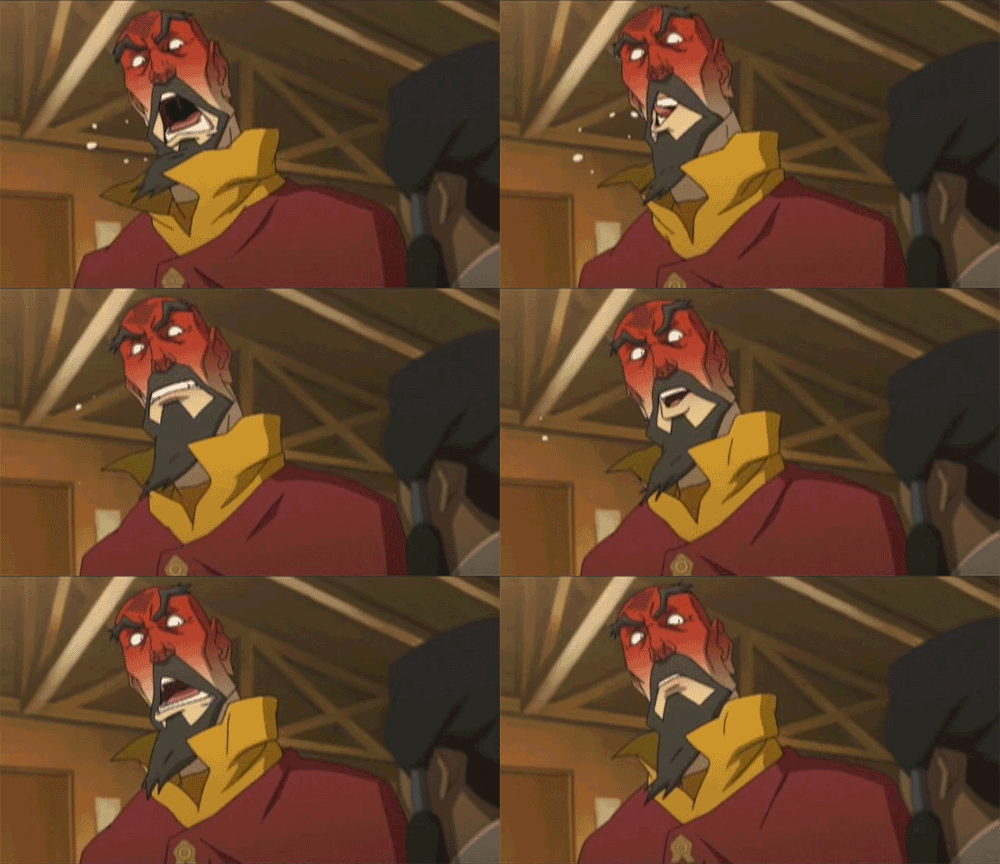
So sometimes he loses his cool.

Tenzin initially imposes strict restrictions on Korra since he sees structure and discipline as key to teaching. However he didn't give much consideration of the best way to adapt his teaching technique to nurture Korra and help her learn considering her rebellious nature.

However he eventually realises that by giving Korra the tools she needs and letting her use those tools in a practical setting she thrives. He also offers support for her emotionally, telling her he is always there if she needs to talk. He is truly proud of Korra, not only as his student but for who she is and as the Avatar.

For her own part, Korra is resistant to Tenzin's style of teaching and takes a lot of the frustration she feels at not being able to Airbend out on him. She also doesn't take well to his slightly patronising paternal instincts and desire to protect her at the cost of her freedom. But at that same time she respects him greatly as a mentor and confidant, eventually opens up to him about her fears.

Her complex feelings towards Tenzin sets up a breakdown in their relationship in Book 2 that blossoms into something truly wonderful by Book 3 but we'll get there when we get there.

We've got some bloodbending brothers to talk about in the meantime.

The antagonists of Book 1, Noatak and Tarrlok, have a complicated sibling rivalry. In "Skeletons in the Closet", the penultimate episode of the season, we learn from Tarrlok that Amon, the Equalist leader and Big Bad of the season, is actually his brother Noatak and from the Northern Water Tribe like himself.

He then goes into their tragic backstory. They are the sons of Yakone, a bloodbending crime boss who was escaped from Republic City after Aang took away his bending. When their father finds out that his sons are both Waterbenders, he starts training them in the taboo art of bloodbending. His training is intense and harsh as he wants to use his sons as a means to get back the criminal empire that was taken from him.

Tarrlok doesn't like bloodbending because of the unease he feels forcibly manipulating living creatures although Noatak is a prodigy. Throughout their training Tarrlok and his brother drift apart as Noatak becomes increasingly detached. Eventually Noatak turns on their father and leaves.

As an adult, Tarrlok makes a decision to go to Republic City, not to control it the way his father did through crime but lead it through legitimate channels. He works his way onto the City Council and sets up the task force charged with taking down Amon (who he doesn't know is his brother yet).

It doesn't go that well for him.

The Brothers Bad offer an interesting examination of the perils of parental pressure. Yakone pushes his sons to excel in a field he has chosen for them with little to no consideration of their own desires. He envisions who they want to be in order to vicariously get his own vengeance on Republic City.

Both of his sons reject what he wanted them to become. However due to their own ambitions, they end up becoming exactly what their father wanted anyway- the antagonists of the story instead of the heroes they wanted to become.

This is clear in Tarrlok's apology to Korra (for the whole bloodbending and kidnapping her thing),
"Avatar Korra. I am truly sorry for all that I did to you. I thought I was better than my father, but his ghost still shaped me. I became a soldier of revenge, just like he wanted me to be. And so did my brother."
So he decides to end their sad tale with murder-suicide. You know, for kids.

Now I've only begun to scratch the surface of the network of relationships within the series. I didn't get to mention Asami's highly complicated relationship with her father (who turned out to be an Equalist and not at all the man she thought he was), Tenzin's family and his wife Pema, or even Lin as Tenzin's old flame and her interactions with Korra.

Legend of Korra didn't always handle things perfectly. It made missteps here or there where the wider implications of the story they were telling wasn't considered and some elements didn't quite work but it did present a rich and varied text full of complicated and nuanced interpersonal relationships worth exploring.

The next one of these Korra posts will come out once I finished Book 2 so don't hold your breath since it might be a while. Don't worry though, I'm sure I'll find something else to write about in the meantime.


References:

Love Triangle - TV Tropes

The Legend of Korra: Deliberately Deconstructed - beccatoria

Korra's Relationships - Avatar Wiki

Borra: The Greatest Bromance Ever Told - LoK Gifs & Musings

Bald Mentor Appreciation Day - Nerdswole

Tarrlok's Relationships - Avatar Wiki

Friday, 3 June 2016

High Fantasy Versus Low Reality: What Makes Fiction Real

This wasn't the thing I was going to write about this week. I was going to write about Avatar: The Legend of Korra but then I saw an article on the latest episode of Game of Thrones which made me want to write about something completely different instead.

The article in question was by Fandom Following and argued that the show doesn't deserve critical analysis examining the motivations of its characters or whether it is providing commentary worthy of discussion.

The primary reason for this is because Game of Thrones doesn't have a consistent internal logic since the writing continually breaks the established rules of its own world.

"Listen to them, son. It doesn't make sense how one episode you needed to hold a root of the weirwood tree to have a vision but the next you stay in a vision long after letting go of the root. And no, 'because magic' is not an acceptable answer."

Game of Thrones often tries to have it both ways. The show writers defend the use of rape for drama, explaining it is part of "the reality of this particular world" of brutal patriarchy. However they still want to have ladies occasionally be sassy or talk back to men for a fist-pumping moment which makes no sense in a toxic misogynistic environment.

Or as Fandom Following explains,
Because you absolutely cannot pretend that in a world where Talla is not allowed to express that her future husband isn’t appealing to her without being silenced, her mother would even think to speak out against Randyll in order to defend a wildling that mothered the illegitimate child of her disinherited son. Yet not only did she speak out, she did so in front of others, and in such a manner that was meant to shame him.

Why would a blatant and violent sexist like Randyll allow his wife to publicly shame him like this?

But I don't want to focus on Game of Thrones since I wrote about the show last week. Rather I want to examine the critique that since fantasy novels have a vaguely medieval setting, they should therefore be 'historically accurate' or gritty. This is often a criticism leveled against high fantasy works, things like The Lord of the Rings or The Wheel of Time in contrast to 'realistic' fantasy series like A Song of Ice and Fire.

The critique often follows something along the lines that it is unrealistic the main protagonists of a highly dangerous epic adventure are likable and all survive. How can it be taken seriously unless there is the real danger that any character could possibly die? Essentially, the real Middle Ages were a brutal place and since fantasy novels superficially reflect the Middles Ages, they should reflect that brutality in order to have real merit.

I'm sorry but I call bullshit. There is no reason why a quote/unquote gritty fantasy world should be considered more seriously than a high fantasy world. Darkness can exist in well-lit worlds, characters don't have to be anti-heroes in order to be nuanced or complicated, and compelling storytelling doesn't have to rely on a gritty setting full of death.

Captain America: Civil War dealt with complex themes of privacy vs security, agency vs accountability, freedom versus governance, and loyalty versus betrayal but I don't know if the setting was gritty enough for me to take it seriously.

Let's focus on death for a moment since so many shows nowadays follow the 'anyone can die' mould as way of showing how realistic their fictional world is. Todd VanDerWerff wrote an in-depth and brilliant article for Vox on how the proliferation of death on our television screens in recent years has actually diluted its narrative or emotional impact.

When you rely on death as a plot point, it becomes reduced to shock value and cheapens the narrative. A fictional world doesn't need to rely on the death of one or more of its main characters to raise the stakes in order for us to be invested.

For example, Harry Potter is a high stakes tale where a bespectacled boy battles wizard Hitler but we all knew going in that Harry, Ron, and Hermoine were going to survive. We didn't need their deaths to become invested in the world.

I can't possibly invest in this. They're laughing and none of them die.

Death can and should happen in fiction but it needs to matter. I mean there was death in Harry Potter but it had a purpose. The first character of any worth to die was Cedric Diggory but that was in the fourth book in the series and he was a minor secondary character. J.K. Rowling spent the three previous books developed a rich world inhabited by identifiable characters we related to and used his death to mark the severe consequences of Voldemort's return in a real way.

And Cedric's death had an effect. It signaled a change in the series as the tone become more adult and dark. One that heralded later more significant character deaths like Sirius Black in Order of the Phoenix. As Harry's godfather, Sirius' death was dramatically significant as he lost one more link to his parents and his sense of family.

This leads to Harry's first real emotional breakdown in the series as it all becomes to much for him to handle and he calls Dumbledore, his other father-figure, out on his bullshit. But Harry then learns from this what makes him different from Voldemort and how he will inevitably defeat the Dark Lord - he has the capacity to love.

I know it hurts Harry but at least his death wasn't a cheap shock.

Of course, there is Dumbledore's own death in The Half-Blood Prince but yet again, that wasn't an attempt to show the reality of this particular world so much as it served an emotional and narrative function. Dumbledore's death was effective emotionally not only because he was a beloved character but because his death was handled with sensitivity.

And thematically it made sense for him to die. Over the course of the story Harry lost his adoptive father-figures in order to become his own man and face He-Who-Was-Already-Named-In-This-Post. It could be seen as a metaphor for growing up since he could no longer rely on his 'father' to swoop in and save him.

I guess what I'm trying to say is that fantasy doesn't have to mimic the real world or be dark and gritty in order to be realistic. It just needs to establish the rules of its own fictional world and follow them. As Tumblr user Lindira puts it:
Fantasy does NOT have to follow real world rules. Fantasy does NOT have to relate to some real world event, country, concept, law, or history. Fantasy does NOT have to mirror any particular time period or country, even if you’re basing your world on a real world one. There is NO SUCH THING as “historical accuracy” in fantasy as it relates to the real world. 
THE ONLY THING Fantasy has to do to be believable is follow the established rules OF ITS OWN WORLD. Fantasy can literally be anything you imagine it to be.
This is why we all accept that Superman can fly and shoot laser beams out of his eyes but get upset when writers pull shit like this out of their arse:


Nothing in Superman's list of powers in the movies (or comics) ever mentioned or hinted at being able to throw cellophane S shields at his enemies. It is obvious that the writers didn't care this flew in the face of Superman's established powers.

In fact, the final act of Superman II is unfortunately riddled with this lack of care, which is a shame because I love that movie. Like Superman can suddenly make holographic copies of himself because that is somehow a thing.

And then there is the kiss. You know the one. Where Superman kisses Lois so hard she forgets all the events of the movie. There are so many things wrong with that that I don't even want to touch it.

You can't just make up things whenever you feel like it if they go against the rules of the fictional world. It just doesn't work. The only thing it shows is that the writer either doesn't care about either the fictional world they have created or their audience.


Now that I've established that, let's discuss The Wheel of Time for a bit. I am currently reading the series for the first time and have only finished the first three books so far but since that's a trilogy, it's as good a place as any to provide some reserved analysis.

I mentioned up top that due to the fact that The Wheel of Time is a high fantasy series where (as far as I've read) none of the main characters die and lacks the 'anyone can die' approach which is all the rage nowadays, it somehow is less serious than a work like A Song of Ice and Fire.

That argument seems to be based on the false premise that grim = realistic, one I've spent some time diffusing. It also ignores the fact that Robert Jordan was going for something completely different to George R.R. Martin. Now bear in mind that I am by no means well versed the works of either author but here's how I see the distinction between the two series.

To my mind Jordan is more interested in exploring notions of prophecy and determinism, the resistance between who the characters believe themselves to be and who they were fated to become, with an emphasis on duality. There's also a focus on the cyclical nature of time for some reason.

Hmm, an ouroboros entwined with a wheel. Whatever could it mean?

Jordan used his richly imagined fantasy world as a backdrop to explore those ideas in a manner which couldn't have been done in quite the same way if the story was set in a more 'realistic' setting. On the other hand, while Martin's fictional world is home to magic and mystical creatures like dragons, his focus is more on the medieval aspect of fantasy.

Martin uses fantasy to create as an a brutal, patriarchal feudal world and used the medieval values of that setting to explore the workings of sexism and ableism (and to a lesser extent racism), the expression of masculinity, and personal identification.

In A Song of Ice and Fire, rape is a very real thing since it is a symptom of the toxic patriarchal world Martin built and exploring, but it would seem quite anachronistic in a series like The Wheel of Time. This isn't to say that the regularity of rape within his narrative is completely necessary for the 'realism' of Martin's fictional world but it does make sense within its internal logic.

But just because his world is more brutal doesn't necessarily make it more serious. Both A Song of Ice and Fire and The Wheel of Time deal with gender politics and both have explored the cruelty of slavery or bondage to some degree for example.

It might not be clear but the lady in green is Egwene and she has a leash around her neck that the lady in red and blue is holding to control her. This is from the less serious The Wheel of Time series by the way.

Furthermore, while The Wheel of Time could be said to have a lighter tone overall than A Song of Ice and Fire, the historical backstory that lays the foundation for the series is undeniably dark. From Wikipedia,
A century after the initial breach of the Dark One's prison, open warfare occurs between the forces of the Dark One and those of the Light, until the chieftain Lews Therin Telamon, known as the Dragon, leads a force of channelers and soldiers to reseal the prison; whereupon the Dark One inflicts a malediction that drives male channelers of the One Power insane. 
Thus affected, the male channelers create earthquakes and tsunamis altering numerous landscapes in an event that comes to be called "The Breaking of the World." Lews Therin himself kills his friends and family, and is known afterwards as "Kinslayer." Given a moment of sanity by Ishamael, chief among the Dark One's servants, Lews Therin commits suicide.
Remember this is the story which some dismiss as 'high fantasy' like that's a bad thing and less worthy of attention. And that's my point. Fantasy can be whatever it wants to be. It doesn't have to be 'adult' in tone to handle some heavy stuff and it doesn't have mimic the real world to be realistic.

It just has to follow its own rules. Even if those rules include magic.


References:

Stop Pretending Game of Thrones is Worthy of Analysis - Fandom Following

Game of Thrones writer defends Sansa scene in heartfelt new commentary - Entertainment Weekly

Fantasy Does Not Have To Follow Real World Rules - Lindira

TV is killing off so many characters that death is losing its punch - Vox

A'dam - The Wheel of Time Wiki

The Wheel of Time Wikipedia page